
Table of Contents
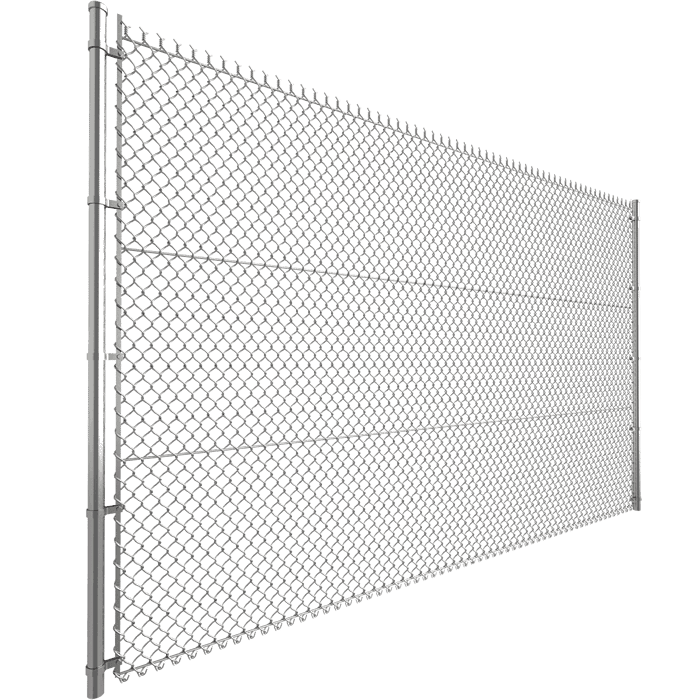
For most residential projects in the United States, 200 feet of chain link fence may cost approximately $2,000 to $4,000 for a basic professionally installed galvanized system. A taller fence, heavier wire, vinyl coating, difficult soil, multiple gates, or commercial-grade framework can push the total closer to $4,000 to $8,000 or more. DIY materials may cost much less, but the price shown for a roll of mesh is never the full project cost—you still need posts, rails, fittings, concrete, gates, tools, and delivery. Current national pricing guides place professional chain link installation within a broad range of roughly $8 to $40 per linear foot, with many ordinary projects falling around $10 to $20 per foot.
What Is the Average Cost of 200 ft of Chain Link Fence?
There is no single correct price, but a 200-foot fence is long enough that small specification changes become expensive.
An extra $3 per linear foot adds $600 to the project. One larger driveway gate can affect the budget more than changing several rolls of mesh. This is why a customer who asks only, “How much is 200 feet of chain link?” usually receives a very wide estimate.
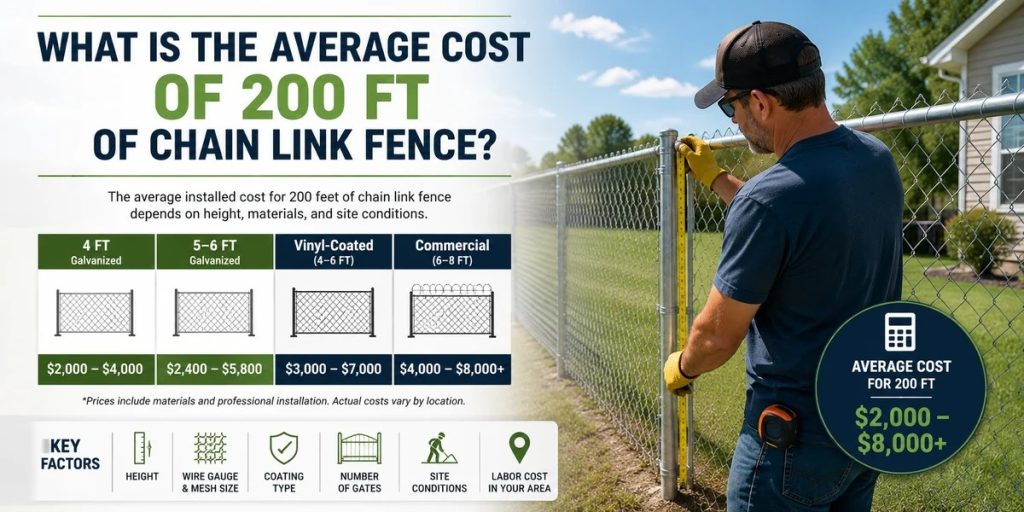
A practical starting point is shown below:
Fence configuration | Approximate installed cost for 200 ft |
Basic 4 ft galvanized fence | $2,000–$4,000 |
5–6 ft galvanized fence | $2,400–$5,800 |
Vinyl-coated residential fence | $3,000–$7,000 |
Tall or commercial-grade fence | $4,000–$8,000+ |
These figures should be treated as budgeting ranges rather than quotations. Angi’s 2026 data places 4-foot chain link installation at about $8–$20 per foot, while a 6-foot fence can range from approximately $10–$29 per foot. Eight- and ten-foot systems can cost considerably more.
The mesh is only one part of the fence.
In our experience, first-time buyers often calculate the cost by multiplying the price of a mesh roll by the number of rolls required. That calculation ignores terminal posts, line posts, top rails, tension bars, brace bands, tie wires, concrete, gate hardware, freight, and labor.
The result looks attractive on paper. Then the real quotation arrives.
How Much Does Chain Link Fence Cost Per Foot?
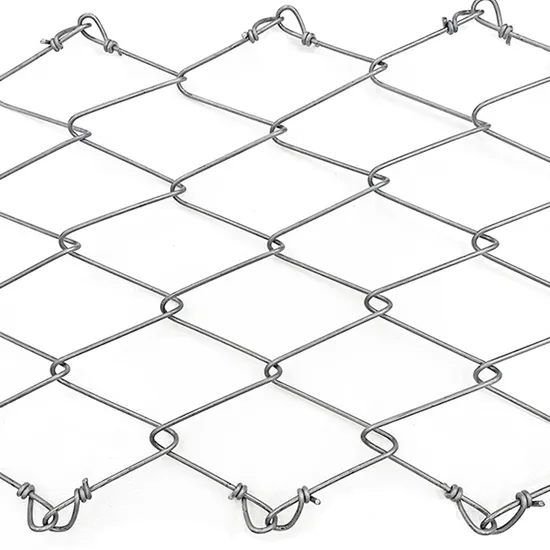
Professional chain link fence installation commonly costs around $10 to $20 per linear foot for a straightforward residential project, although the broader market range may run from approximately $8 to $40 per foot. Height, finish, location, site access, and contractor demand explain much of that difference.
A per-foot price is useful, but only when you know what it includes.
Price type | Typical range | Usually includes |
Galvanized mesh only | $5–$8/ft | Fence fabric, not the complete system |
DIY material package | $3–$15/ft | Mesh and basic components; scope varies |
Standard installed fence | $10–$20/ft | Materials and normal installation |
Upgraded or difficult project | $20–$40+/ft | Taller fence, coating, heavier frame or difficult site |
HomeAdvisor estimates galvanized mesh itself at roughly $5–$8 per linear foot and notes that materials may account for about half of a typical project budget. That does not mean a complete DIY fence will cost only $5 per foot. Posts, concrete, rails, fittings, gates, freight, waste, and tool rental must still be added.
Personally, I think the phrase “cost per foot” causes almost as many problems as it solves. It allows fast comparison, but two fences with the same length can be completely different products.
One may be a four-foot backyard boundary on flat soil. The other may be an eight-foot warehouse perimeter with heavy terminal posts, security extensions, vehicle gates, and concrete footings.
Both are chain link fences.
They should not have the same price.
Material Cost vs Installation Cost: What Will You Pay?
For many standard projects, materials and professional installation each represent a substantial part of the final cost. A rough 50/50 split may be useful during early budgeting, but it becomes inaccurate when the site is unusually easy or unusually difficult.
A simple 200-foot run on open, level ground may require relatively predictable labor. Rocky soil is different. So is a narrow backyard where equipment cannot enter and every hole must be dug manually.
Cost category | What affects it most |
Chain link fabric | Height, gauge, mesh opening and coating |
Posts and rails | Pipe diameter, wall thickness and post spacing |
Concrete | Hole depth, soil and local frost requirements |
Gates | Width, frame strength, hinges and locking system |
Labor | Ground conditions, access, slope and local rates |
Extra work | Old-fence removal, grading, permits and utility marking |
A common estimating mistake is to include the mesh and posts but forget the terminal assemblies. Corner posts, end posts, gate posts, tension bars, brace bands, rail ends, and hardware do not look expensive individually. Across a complete project, they add up.
We have also found that buyers sometimes save money on the fabric and then specify an unnecessarily heavy framework—or do the opposite. The cheapest combination is not always the most balanced one.
From an engineering perspective, the fabric, posts, rails, and footings should work as one system.
How Do Fence Height, Wire Gauge, and Mesh Size Affect the Price?
Height has the most visible effect. A six-foot fence uses about 50% more fabric than a four-foot fence before considering stronger posts, deeper footings, additional handling, or more difficult tensioning.
Current installation ranges illustrate the change:
Fence height | Approximate installed price per foot |
4 ft | $8–$20 |
5 ft | $9–$22 |
6 ft | $10–$29 |
8 ft | $12–$34 |
10 ft | $17–$40 |
Wire gauge matters too. A lower gauge number generally indicates thicker wire. Heavier wire uses more steel and provides better resistance to cutting, deformation, animal pressure, and repeated impact, but it also raises material weight and freight cost.
Smaller mesh openings usually cost more than standard openings because more wire is needed for the same fence area. They may be justified for sports facilities, animal enclosures, high-security sites, or applications where climbing and object passage must be limited.
For an ordinary residential property, the heaviest available wire is often unnecessary.
That is not underspecifying. It is selecting the product for the actual job.
A frequent purchasing problem occurs when a customer requests “commercial quality” without defining what that means. The supplier may quote heavier fabric, larger posts, thicker rails, and smaller mesh. The customer then believes the price is too high, even though the quotation matches the request.
Clear specifications prevent this.
Galvanized vs Vinyl-Coated Chain Link Fence: Which Costs More?
Vinyl-coated chain link fencing normally costs more than standard galvanized fencing. The additional coating improves appearance and gives the steel another protective barrier, but it adds manufacturing steps and material cost. National pricing guides also show vinyl-covered systems above basic galvanized options.
Feature | Galvanized chain link | Vinyl-coated chain link |
Initial cost | Lower | Higher |
Appearance | Industrial, metallic | Softer, usually black or green |
Common use | Warehouses, farms, utilities, general boundaries | Homes, parks, schools, landscaping |
Surface protection | Zinc coating | Zinc plus polymer coating |
Repair visibility | Usually less noticeable | Scratches may expose the metal beneath |
For a warehouse boundary, galvanized fencing often provides the better cost-to-performance ratio. For a landscaped home, school, park, or recreation area, black or green vinyl coating may justify the additional cost because the fence is less visually dominant.
Vinyl coating is not automatically better for every project.
We once reviewed the sort of specification commonly used for an industrial yard where nearly every component had been upgraded for appearance, even though the fence would sit behind storage containers and loading equipment. The coated fabric added cost but almost no practical value. A heavier galvanized system would have been the more sensible purchase.
Aesthetics matter.
But location matters too.
DIY vs Professional Installation: Which Option Saves More Money?
DIY installation can reduce the cash cost because you are not paying a contractor’s full labor charge. Material-only estimates may start around $3–$15 per foot depending on height, quality, coating, and what the package includes. For 200 feet, that suggests a broad initial material budget of approximately $600–$3,000 before special gates, equipment, delivery, permits, waste, or unexpected site work.
The real question is not whether DIY is cheaper.
It usually is.
The question is whether the savings are worth the time and risk.
DIY may make sense when… | Professional installation may be better when… |
The ground is level and easy to dig | The site is rocky, sloped or heavily landscaped |
The fence is only 4–5 ft high | The fence is tall or commercial-grade |
There are few corners and one simple gate | There are several gates, corners or elevation changes |
You already own suitable tools | Equipment must be rented or purchased |
Schedule is flexible | The property must be secured quickly |
Stretching the mesh is where many DIY projects go wrong. Loose fabric looks untidy, while excessive tension can pull posts out of alignment. Gate posts are another trouble spot. A gate that works on installation day may begin dragging after the soil settles or the post moves.
In our experience, a capable homeowner can install a basic chain link fence successfully. A long, tall, sloped, or security-sensitive fence is another matter. Professional installation may cost more initially, but correcting leaning posts, uneven fabric, or a poorly aligned vehicle gate is rarely cheap.
For a realistic quotation, provide the supplier or contractor with the total length, fence height, wire gauge, mesh size, surface finish, number and width of gates, corner count, terrain photos, soil conditions, and delivery location.
Without those details, a price for 200 feet is only a guess—and probably not a very useful one.
Related Post might be HELPFUL to you: How to Install Chain Link Fence

 English
  Spanish
  Portuguese
  German
  French
  Italian
  Japanese
  Korean
  Russian