


Table of Contents
If a landscape contractor needs twenty gabion cages next week, importing them from China is probably a bad idea. If a distributor buys several containers every quarter, buying locally may be the expensive option. That is roughly where the China sourcing question starts. Gabion boxes themselves are not complicated products, but quotations can be misleading when wire diameter, selvedge wire, coating, mesh opening or diaphragms are not defined. This article looks at ten Chinese gabion manufacturers worth comparing, with Huade first for custom and bulk orders, and—more importantly—explains what I would check before placing a large order.
What Is a Gabion Box?
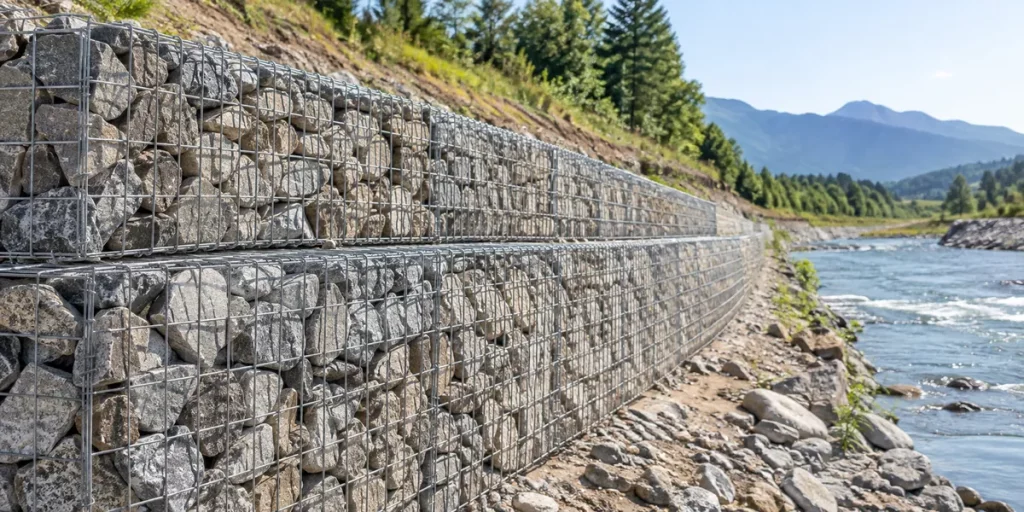
A gabion box is a steel wire cage filled with stone.
Once assembled and filled, the weight of the stone gives the structure stability, while the open spaces between the rocks allow water to drain through. That drainage is one reason gabions work so well for retaining walls, riverbanks and erosion-control projects.
Most engineering gabions use double-twisted hexagonal woven mesh. Welded-wire cages are also common, particularly in landscaping and architectural work.
A typical woven gabion has more parts than buyers sometimes realize: mesh panels, diaphragms, heavier edge or selvedge wire and lacing wire.
That last point matters when comparing prices. A supplier can reduce the weight of a cage without changing its external dimensions.
Two boxes marked 2 × 1 × 1 m are not necessarily the same product.
Woven or Welded? The Choice Matters More Than It Looks
I normally separate gabion projects into two groups before talking about price.
Woven gabions are flexible. If the ground settles slightly or a riverbank moves, double-twisted mesh can deform while the cage continues holding stone together.
Welded gabions are much more rigid. They produce straight faces and sharp corners, which is why architects and landscape designers often prefer them.
Type | Where I would normally use it | Main reason |
Double-twisted woven | Rivers, slopes, retaining walls | Tolerates movement |
Welded gabion | Landscaping, decorative walls | Cleaner appearance |
Reno mattress | Riverbeds, channels | Large-area erosion protection |
Heavy-duty woven gabion | Infrastructure | Heavier wire/coating |
Personally, I think welded gabions are overused in online product articles.
They photograph beautifully.
But if I were dealing with a moving riverbank or an embankment expected to settle, I would rather have the deformation tolerance of double-twisted mesh than perfectly straight welded corners.
Where Gabions Actually Work Well
Gabions are good at jobs where weight, drainage and some ability to tolerate ground movement are useful.
That includes riverbank protection, slope stabilization, road embankments, retaining structures, drainage channels, bridge approaches and flood-control works.
They also show up in gardens, hotels and commercial landscapes.
The difference is easy to overlook.
A landscape designer may care about uniform stone size, straight welded panels and clean corners. An engineer specifying river protection may care much more about wire coating, double-twist integrity and what happens when part of the foundation moves.
The cage looks similar from a distance. The job is not.
Top 10 Gabion Box Manufacturers in China
This is not a claim that the number-one company is universally better than number ten. Some factories are stronger in woven hydraulic gabions, some have broader mesh ranges, and others may be more suitable for an importer combining several products in one order.
1. Huade
Huade would be my first comparison for a custom or repeated B2B gabion order.
The company operates in Anping and supplies gabion products alongside fencing and other wire-mesh systems. That broader manufacturing background is useful for importers who are not buying retail quantities.
When an inquiry arrives saying “Gabion box, 2 × 1 × 1 m. Please quote.” there is still quite a lot missing.
We need to know the mesh opening. Is the main wire 2.7 mm? What is the selvedge-wire diameter? What lacing wire is required? Are diaphragms installed every meter? Is the wire zinc coated, Galfan coated, or PVC coated over metallic coating?
Until those questions are answered, the box dimensions do not tell us enough to compare quotations properly.
That is also where Huade makes more sense for distributors and engineering buyers than for somebody buying a few garden baskets. The useful part is the ability to discuss specifications, packing and repeated orders as one system.
One thing I would pay particular attention to is packing. Gabions normally ship collapsed in bundles. If the bundles are tied badly, panels slide during unloading and lacing wire ends up mixed between packs.
Nobody puts that problem in a glossy brochure. Site crews notice it very quickly.
2. YSH Gabion / Anping Yongsheng
Yongsheng is one of the more specialized gabion producers on this list.
Its range includes woven boxes, Reno mattresses, gabion mats and welded products. I would put it on a shortlist for hydraulic or erosion-control work before I would consider it simply as another general wire-mesh supplier.
Specialization does not automatically mean the cheapest price. Sometimes that is exactly why it is worth comparing.
3. Anping Shengsen Metal Products
Shengsen offers galvanized, Galfan and PVC-coated gabions together with welded products and mattresses.
If coating choice is one of the difficult parts of the project, I would want their quotation in the comparison. Not because every project needs Galfan or PVC. Many do not.
4. Anping Wanquan Wire Mesh Products
Wanquan presents itself as a gabion-focused manufacturer rather than a company adding gabions to a huge unrelated catalog.
For river engineering and water-conservancy applications, that focus is useful.
I would still request a technical sheet and sample. A specialist logo on a website is not a substitute for checking the wire.
5. Yuelian Wire Mesh
Yuelian is worth looking at when the project involves double-twisted mesh with galvanized, Galfan or PVC-coated wire.
I would probably compare it more closely on corrosion-sensitive projects than on decorative landscaping work.
6. Huagu Metal
What interests me about Huagu is its emphasis on controlling multiple manufacturing stages rather than only assembling finished cages.
For large jobs, wire preparation, weaving and coating consistency matter.
Still, vertical integration is a manufacturing advantage—not proof that every finished shipment will be perfect. Inspection still matters.
7. Hechuang Tianding Wiremesh Products
Hechuang Tianding offers both woven and welded gabion products.
That is useful when a buyer is still deciding whether a project should use an engineering-style flexible cage or a rigid architectural system.
I would ask them to quote the two separately rather than treating one as a substitute for the other.
8. Jindexin Metal Products
Jindexin is another Anping manufacturer with gabion boxes, Reno mattresses and related heavy hexagonal mesh.
For a large woven-gabion inquiry, it provides another useful factory benchmark.
Sometimes three serious quotations tell you more than fifteen marketplace messages.
9. Shengxiang Metal Products
Shengxiang manufactures gabion boxes and other wire-mesh products.
It may make sense for distributors that want several mesh categories in the same purchasing program rather than gabions alone.
That can help with consolidated sourcing, although it can also make quality inspection more complicated if several products are loaded together.
10. Jinnuo Hardware & Wire Mesh
Jinnuo has a long wire-mesh manufacturing background and includes gabion mesh among its products.
I would consider it another useful comparison factory, especially for buyers already sourcing other mesh products from Anping.
Company age is nice to know. A current sample is more useful.
A Cheap Quote That Wasn't the Same Product
This kind of mistake is common enough that it is worth discussing.
Imagine three factories quoting a 2 × 1 × 1 m, 80 × 100 mm gabion.
One quotation is noticeably cheaper.
At first glance, purchasing assumes the supplier has better pricing.
Then the technical sheets are put side by side.
The cheaper cage uses lighter main wire. Its edge wire is also smaller. Another supplier has quoted a heavier selvedge wire and a different coating system.
Nobody necessarily made a mistake. They were quoting different cages against an incomplete inquiry.
This is why I dislike negotiating gabion prices before the specifications match.
You can always make a cage cheaper by removing steel. That does not mean you should.
What I Check Before Comparing Gabion Factories
I am more interested in boring technical answers than factory slogans.
I want the supplier to confirm:
- mesh type and opening
- main mesh wire
- selvedge or edge wire
- lacing wire
- diaphragm spacing
- coating type
- finished box dimensions
- bundle quantity and packing method
Then I want to see whether the sample matches those numbers.
There is another detail buyers sometimes overlook: wire diameter tolerance.
If the purchasing specification is sensitive, do not assume every coil measures exactly the nominal number printed on a quotation. Agree on tolerances before production.
What to Put in Your RFQ
A usable inquiry can still be short.
Requirement | Example |
Type | Double-twisted woven gabion |
Box size | 2 × 1 × 1 m |
Mesh opening | 80 × 100 mm |
Mesh wire | 2.7 mm |
Selvedge wire | 3.4 mm |
Coating | Galfan + PVC |
Diaphragm | Every 1 m |
Quantity | 3,000 sets |
Application | Riverbank protection |
Destination | Rotterdam |
If an engineering standard applies, attach it.
A drawing is even better.
Five clear minutes at the inquiry stage can save several days of quotation clarification later.
Galvanized, Galfan or PVC?
Standard zinc-coated wire is suitable for many ordinary projects.
Galfan, typically based on a zinc-aluminum alloy coating, is chosen when improved corrosion performance is required. PVC-coated wire adds another protective layer and is useful in wet or aggressive environments.
I would not automatically specify the most expensive coating.
If the cage is being used as a decorative garden wall in a relatively mild inland environment, a high-end hydraulic specification may be unnecessary.
But corrosion protection is also a terrible place to save money when the cage will spend years beside moving water.
Replacement is not pleasant once several tons of stone are inside.
Local Supplier or Chinese Factory?
For twenty cages required next Tuesday, buy locally.
Seriously.
International sourcing only becomes interesting when volume is high enough for the factory economics to matter.
Three thousand cages for a river project are different. So is a distributor buying several containers every year.
In those cases, Chinese manufacturing offers customization and purchasing scale that can offset freight and lead time.
But do not forget storage.
Gabions ship flat, which helps, but several containers of steel mesh still take up space when they arrive.
Common Buying Mistakes
One mistake is treating woven and welded gabions as interchangeable.
Another is asking only about the main mesh wire and forgetting the heavier edge wire.
Coating descriptions are another trap. “Galvanized” is a category, not a complete project specification.
Then there is packing.
Buyers will sometimes negotiate for days over a small reduction per cage and barely ask how many bundles fit in a container or how the lacing wire is packed.
Freight can eat that saving very quickly.
Finally, remember that the cage is only part of the completed structure. Poor stone selection, bad foundation preparation or careless filling can make a perfectly manufactured gabion perform badly.
If I were purchasing a large order tomorrow, I would send the same RFQ to three or four factories, including Huade, inspect the samples and compare the technical sheets before discussing the final price.
Only after the products match does the cheaper quotation really mean cheaper.
Related Post might be HELPFUL to you: 15 Best Palisade Fencing Manufacturers in the World
 English
  Spanish
  Portuguese
  German
  French
  Italian
  Japanese
  Korean
  Russian