
Table of Contents
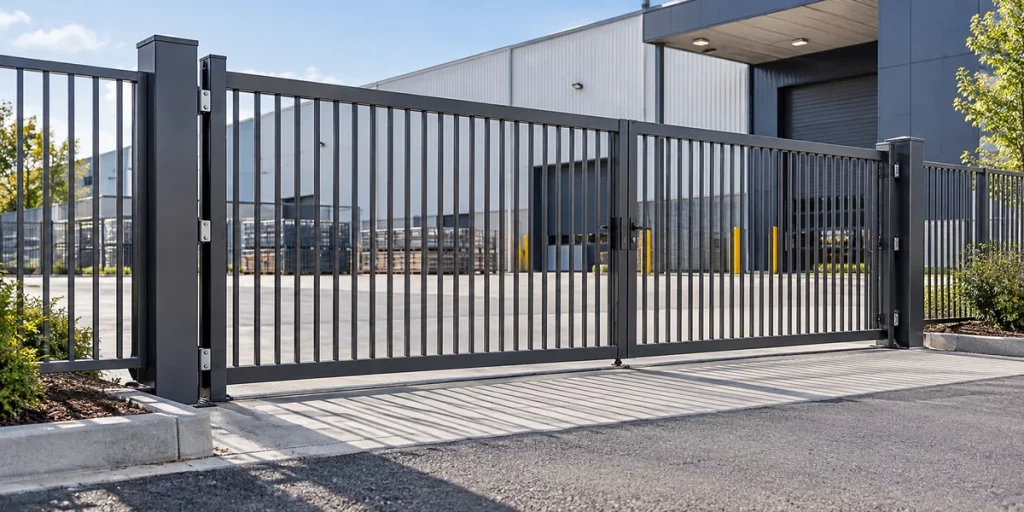
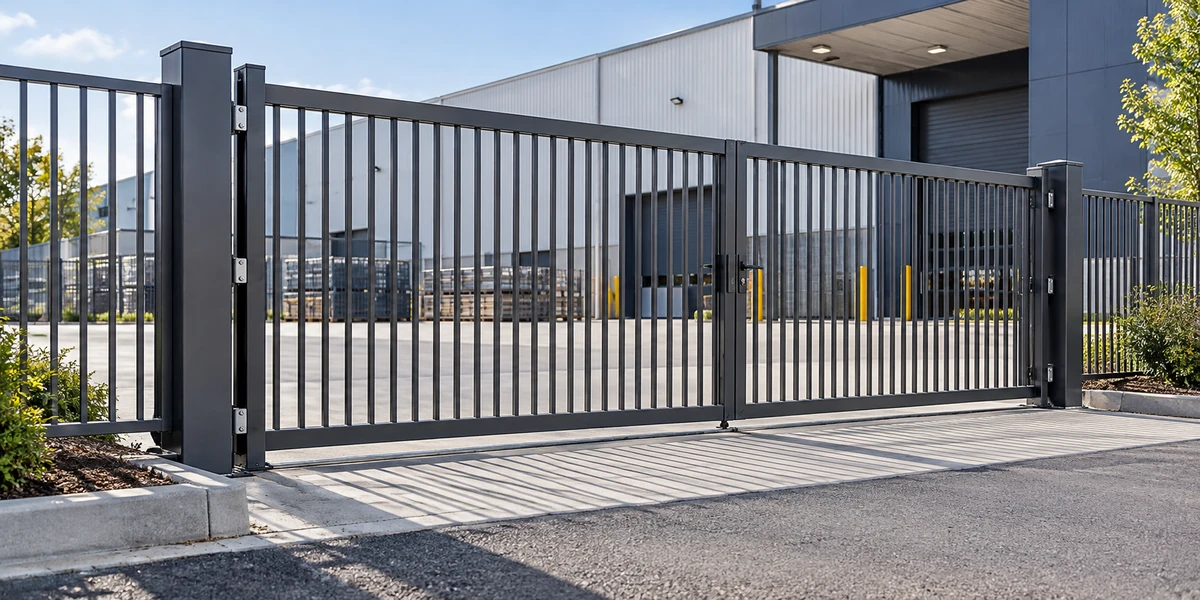
A tubular gate designed for a pedestrian entrance has little in common, structurally, with a five-meter-wide gate at a distribution center. Both may use square hollow steel sections and vertical bars, but the forces acting on their frames, hinges and supporting posts are substantially different.
Width is only one part of the problem. Ground slope determines whether a swing gate has enough clearance. A sliding gate needs space along the fence. Adding a solid privacy panel increases wind exposure, while automation introduces loads and safety requirements that are absent from a basic manually operated gate.
These details are worth resolving before deciding on tube sizes or decorative patterns.
Tubular gate designs are used for residential entrances, commercial properties, warehouses and industrial perimeter fencing. The right arrangement depends on how the entrance is used, the space available and the conditions the gate will face over time.
What Is a Tubular Gate?
A tubular gate is a gate manufactured primarily from hollow metal sections. Square hollow sections (SHS), rectangular hollow sections (RHS) and round tubes are common construction materials.
Most designs have an outer frame connected to internal members. Depending on the opening mechanism, the complete assembly may also include hinges, rollers, tracks, locking components and reinforcement around connection points.
Square and rectangular tubing is convenient for many welded designs because the flat faces simplify cutting, alignment and joint preparation.
Hollow sections provide an efficient way to place material away from the center of a cross-section, which can produce useful bending stiffness without the weight of a solid bar of the same external dimensions.
That does not automatically make a tubular gate lightweight or structurally adequate. A large gate with thick sections and sheet-metal infill may place considerable demands on its supports.
For the person specifying the gate, three decisions come first: the clear opening, the operating method and the site conditions.
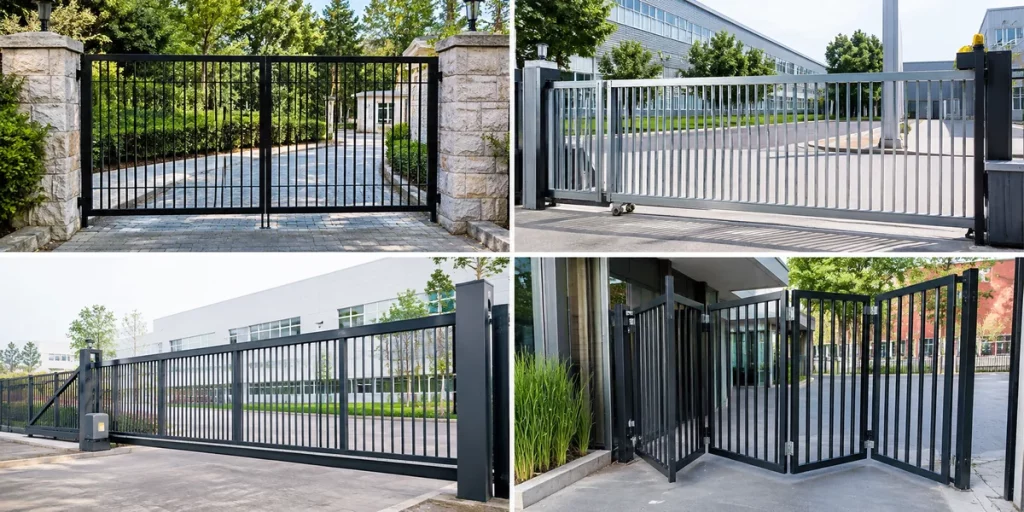
Common Tubular Gate Designs
Single Swing Gates
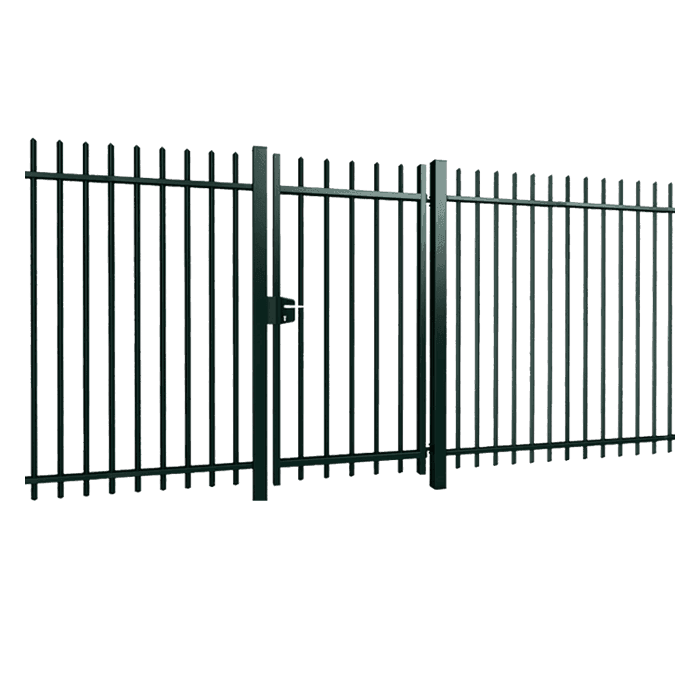
A single swing gate has one leaf supported by hinges along one vertical edge.
For a narrow pedestrian entrance, the arrangement is relatively simple. A latch, suitable hinges and a properly supported frame may be sufficient for manual operation.
As the leaf becomes wider, the mechanical demands increase.
Imagine a gate weighing 100 kg with its center of gravity 1.5 meters horizontally from the hinge line. Gravity creates a moment that the hinge assembly and supporting structure must resist.
Using a simplified static calculation:
M = m × g × L
Where M is gravitational moment, m is gate mass, g is gravitational acceleration (approximately 9.81 m/s²), and L is the horizontal distance from the hinge line to the center of gravity.
100 × 9.81 × 1.5 = 1,471.5 N·m
Increase the gate mass to 150 kg, without changing the center-of-gravity location, and the moment becomes approximately 2,207 N·m. That is a 50% increase.
These figures describe an idealized gravitational moment about a horizontal axis through the hinge location. They are not individual hinge load ratings. Actual hinge forces depend on hinge spacing, connection geometry, wind loading and the supporting structure.
The calculation does show why adding weight to an existing gate can cause problems. A solid privacy panel, heavier decorative sections or additional equipment may require the frame, hinges and posts to be reassessed.
Ground conditions introduce another limitation. If a driveway rises in the direction of opening, the gate may strike the ground before reaching its intended position. This should be established from site measurements, not discovered during installation.
Double Swing Gates
Dividing a wide opening into two leaves can reduce the span of each moving frame. For example, a four-meter vehicle entrance might use two leaves approximately two meters wide instead of one large leaf.
The loads on each leaf and its supporting hardware can be more manageable, depending on the complete design. But two leaves introduce an alignment problem at the center.
The meeting edges have to close correctly. Ground stops, drop bolts and locking hardware must be positioned so that normal movement does not place unnecessary stress on the frame.
The issue becomes noticeable when the entrance is uneven. On a sloping driveway, the clearance beneath one leaf may differ from the other. The center joint might align when both leaves are closed but become difficult to manage through the opening arc.
For automated double gates, movement sequence is another consideration. Where the leaves overlap or use an astragal arrangement, the operating system must coordinate their movement.
Double swing tubular gates remain a practical choice for many residential and commercial entrances, but they require accurate site dimensions and well-planned hardware.
Sliding Tubular Gates
A sliding gate moves horizontally along the boundary instead of swinging into or out of the entrance. This is useful where driveway depth is limited, although adequate space must still be available beside the opening.
A tracked sliding gate runs on wheels supported by a ground-mounted track. The condition of that track directly affects operation. A track crossing a yard where stones, mud or debris collect can require regular attention.
Poor alignment may also increase the force needed to move the gate. When selecting a tracked system, check the pavement, drainage and expected traffic across the entrance.
For an industrial property, the wheel and track arrangement must be compatible with the site’s operating conditions. A sliding gate avoids some swing-clearance problems, but it creates its own maintenance requirements.
Cantilever Sliding Gates
A cantilever sliding gate eliminates the ground track across the vehicle opening. The gate is supported by rollers located to one side and includes a counterbalance section extending beyond the clear opening.
This additional length is necessary for the gate’s operating arrangement. The exact proportions depend on the hardware and engineering design. A counterbalance section should not be sized using a universal percentage without checking the selected system.
The main restriction is side space. A site with a five-meter-wide entrance may have room for vehicles to pass through but insufficient space along the fence for a cantilever gate to retract fully.
Roller supports and foundations are also critical. They carry the forces from the suspended gate throughout its travel.
Cantilever systems can be useful at industrial entrances where a ground track would be undesirable, provided the necessary space and structural support are available.
Bi-Folding Tubular Gates
Bi-folding gates use connected sections that fold together during opening. The arrangement can reduce the operating depth required compared with a conventional swinging leaf.
That advantage comes at the cost of additional hinges, linkages and moving connections. A slight alignment error can affect the folding sequence. As components wear, movement may become less consistent if the mechanism is not adjusted and maintained.
For a frequently used entrance, the availability of replacement parts and access to the operating hardware deserve attention before purchasing.
Bi-folding systems are therefore best evaluated as complete mechanical assemblies rather than as conventional gate frames with extra hinges.
Decorative and Custom Tubular Gates
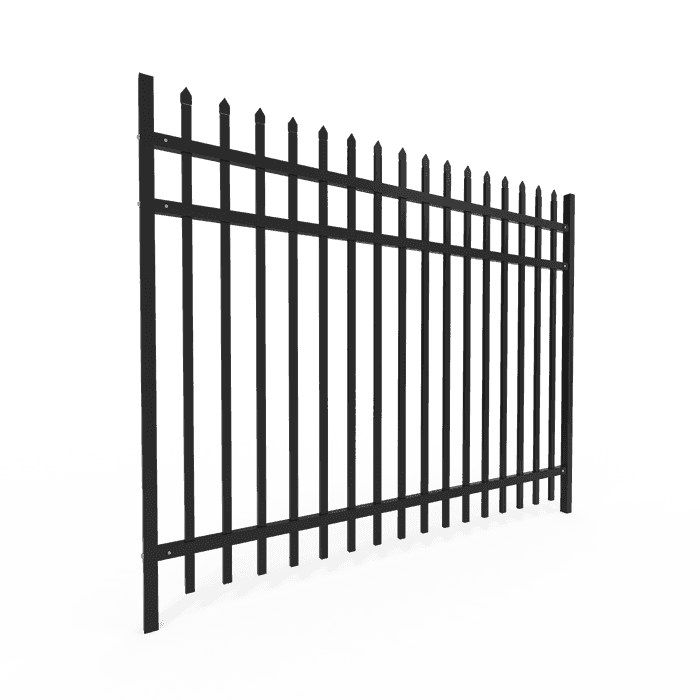
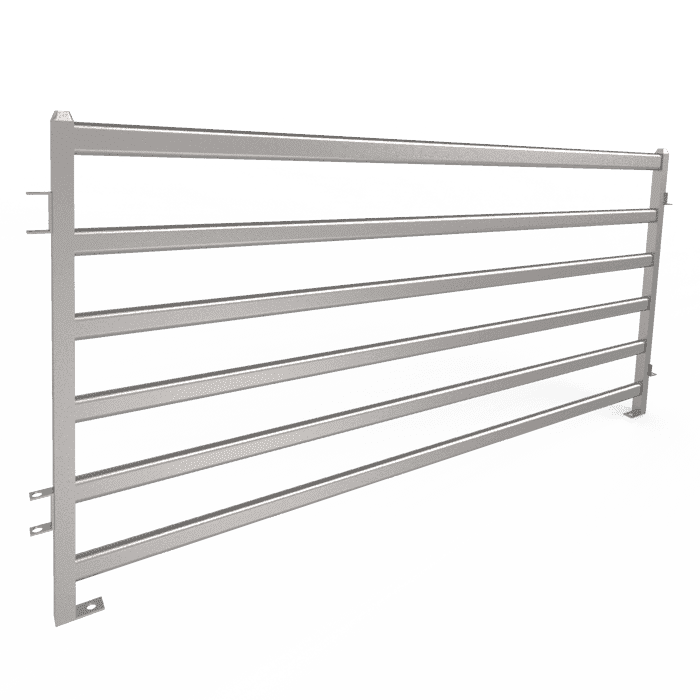
A custom tubular gate may use horizontal bars, closely spaced vertical members, geometric patterns or decorative steel elements. The visual arrangement affects fabrication, weight and sometimes wind loading.
A gate with open tubular infill allows air to pass through much of the frame. Covering it with solid steel sheet changes the exposed surface and can increase wind forces.
The posts and foundations that were adequate for an open gate might not be suitable for a fully sheeted version.
Decorative patterns can also create narrow gaps, sharp projections or climbing opportunities. Such details become especially important at schools, public buildings and pedestrian entrances.
The appearance should be developed alongside the structural and safety requirements, not independently of them.
Which Tubular Gate Design Fits the Site?
Gate Type | Main Advantage | Main Design Limitation |
Single Swing | Simple operating arrangement | Hinge loading and swing clearance |
Double Swing | Divides a wide opening into two leaves | Center alignment and clearance for both leaves |
Tracked Sliding | Does not swing into the driveway | Requires side space and a maintained track |
Cantilever Sliding | No ground track across the entrance | Additional gate length and substantial roller supports |
Bi-Folding | Reduced operating depth in suitable arrangements | More hinges and mechanical components |
Custom Decorative | Wide range of architectural patterns | Geometry, weight and wind exposure vary by design |
Steel, Aluminum or Stainless Steel?
Material choice affects much more than appearance. For tubular gate frames, stiffness, weight, corrosion resistance and fabrication requirements all need to be considered.
Carbon Steel Tubular Gates
Carbon steel hollow sections are widely available and suited to welded fabrication. Their stiffness makes them useful for industrial and commercial gate frames, provided the sections and connections are correctly sized.
Outdoors, corrosion protection becomes part of the specification. Hot-dip galvanizing is one option. Paint and powder-coating systems are also used, sometimes over galvanized steel.
The finish must be compatible with the expected exposure. A coating chosen for an inland residential property may not perform identically at an industrial coastal site.
The fabrication sequence matters as well. Welds, cut edges, vent openings and drainage details should be considered before finishing.
Aluminum Tubular Gates
Aluminum has a density of approximately 2,700 kg/m³, compared with about 7,850 kg/m³ for carbon steel. For the same volume of material, aluminum weighs around one-third as much.
That can be an advantage where operating weight is important. The structural trade-off is stiffness.
Carbon steel has an elastic modulus close to 200 GPa, while a typical structural aluminum alloy is around 69 GPa.
An aluminum member with the same geometry as a steel member will generally deflect more under a comparable load, assuming otherwise similar boundary conditions.
A manufacturer may need to change the section dimensions to achieve the required performance. Aluminum is therefore not a direct structural substitute for steel simply because both materials are available in the same tube sizes.
Stainless Steel Tubular Gates
Stainless steel is used in some architectural entrances and environments where corrosion resistance or a particular finish is required.
Grade 304 is suitable for many applications, while grade 316 provides improved resistance in certain more aggressive conditions. Neither material should be described as completely rustproof.
Fabrication quality, surface finishing, exposure to chlorides and maintenance influence performance.
For projects involving significant chemical or marine exposure, the actual environment should determine the grade.
Material Comparison
Property | Carbon Steel | Aluminum | Stainless Steel |
Approx. Density | 7,850 kg/m³ | 2,700 kg/m³ | 7,900–8,000 kg/m³ |
Approx. Elastic Modulus | 200 GPa | 69 GPa | 190–200 GPa |
Relative Weight at Equal Volume | High | Low | High |
Outdoor Corrosion Protection | Usually requires suitable coating | Depends on alloy and exposure | Depends on grade and exposure |
Main Fabrication Consideration | Welding, coating and distortion | Alloy selection, joining and stiffness | Welding, surface treatment and corrosion control |
Values are approximate and vary with the material grade. They are presented for general comparison, not final structural calculations.
How Tube Dimensions Affect Gate Performance
A gate made with 40 × 40 mm square tubing does not have the same bending behavior as one made from 80 × 40 mm rectangular tubing.
Cross-sectional geometry determines how efficiently a member resists bending about a particular axis. A deeper section can provide greater bending stiffness in the relevant direction, depending on wall thickness and orientation.
For rectangular tubing, rotating the section changes its bending properties relative to the applied force. This is one reason a frame drawing needs to show the orientation of rectangular hollow sections.
Wall thickness adds another variable. Increasing thickness generally increases section area and weight. It also changes resistance to local deformation and influences connection design.
Some nominal dimensions encountered in tubular fabrication include:
Hollow Section | Example Wall Thickness |
40 × 40 mm SHS | 2.0–3.0 mm |
50 × 50 mm SHS | 2.0–3.0 mm |
60 × 40 mm RHS | 2.0–3.0 mm |
80 × 40 mm RHS | 3.0–4.0 mm |
100 × 50 mm RHS | 3.0–5.0 mm |
These are examples of nominal dimensions, not recommendations for a particular gate width or confirmed manufacturer inventory.
A frame made from larger tubing may still perform poorly if its joints are inadequate or its supporting posts are unstable. Diagonal bracing, connection details and the overall arrangement can be as important as the tube dimensions.
For larger gates, the frame and supporting structure require project-specific engineering verification.
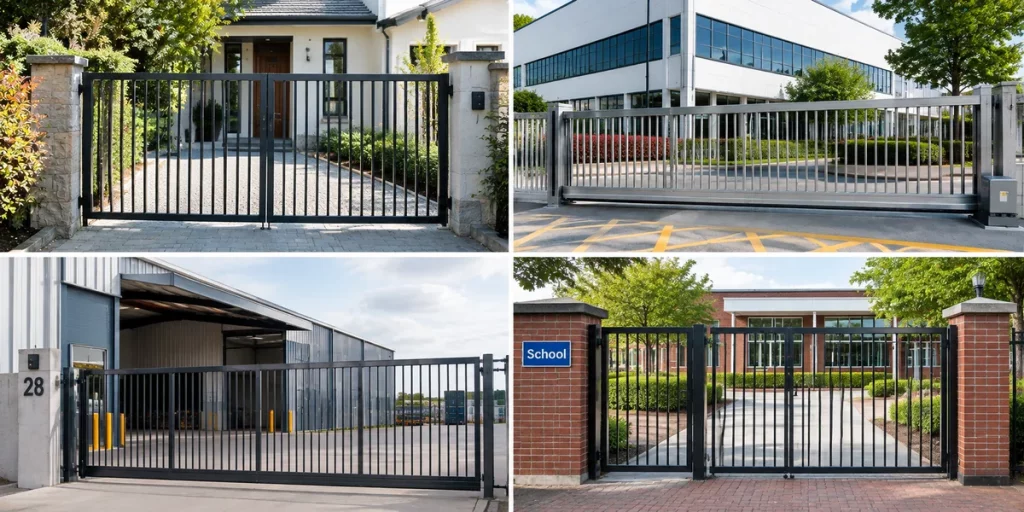
Where Tubular Gates Are Used
Residential Properties
For residential entrances, the main constraints are often driveway width, appearance and available opening space. A single swing gate can be convenient for pedestrian access. A wider driveway may favor a double swing or sliding arrangement.
Privacy requirements also influence the design. Closely spaced tubes provide a different degree of visibility from solid panels. If privacy sheets are added, the resulting wind exposure needs to be accounted for.
Commercial Parking Areas
Commercial entrances may operate repeatedly throughout the day. Hardware durability and access-control arrangements are therefore important.
A sliding gate may avoid obstructing vehicle circulation where space is limited, but the design must accommodate the traffic pattern and the required side clearance.
Automated operation also requires appropriate safety measures around the moving structure.
Warehouses and Industrial Facilities
Industrial entrances are often governed by vehicle movement. A gate that comfortably admits a passenger vehicle may be inconvenient for a large truck approaching at an angle.
Clear opening width, turning paths, ground levels and nearby obstacles should be reviewed before the gate type is finalized.
At a distribution center, the operating frequency may also affect roller, hinge and drive-system selection.
Schools and Public Facilities
Public-facing gates introduce different considerations. Users may include children, pedestrians with mobility aids and people unfamiliar with the operating system.
Latch position, bar spacing, accessible operation, sharp edges and trapping points may all influence the design.
Where a gate is automated, pedestrian interaction and the applicable safety requirements become particularly important. A gate intended for vehicles should not automatically be treated as a suitable pedestrian access route.
Manual and Automated Tubular Gates
Manual gates rely on suitable hinges or rolling hardware and an operating effort appropriate for their intended users.
Automation introduces a drive system, controls and additional hazards associated with movement.
For a swing gate, the actuator arrangement places forces into the leaf and supporting post. For a sliding gate, the motor, drive rack, rollers, guides and stops must function together.
If the gate is difficult to move manually because its hardware is misaligned, installing a more powerful motor is not a proper substitute for correcting the mechanical problem.
Automated gates also require protection against foreseeable crushing, entrapment and impact hazards.
For relevant vehicular gates in the United States, ASTM F2200-24 addresses construction requirements and is used alongside UL 325 requirements for automated gate systems. Other jurisdictions may require different standards and safety arrangements.
Automation should be included in the design brief from the beginning, even if the operating equipment is supplied by a separate contractor.
Fabrication and Installation Problems That Deserve Attention
Welding Distortion
Welding introduces concentrated heat into tubular sections. Without suitable fabrication control, a long rectangular frame may distort or lose squareness.
A distorted frame is difficult to align on site, particularly when two leaves must meet accurately. Fabricators manage this through appropriate joint preparation, fixturing, welding sequences and dimensional inspection.
Unstable Gate Posts
A properly fabricated gate can still sag if its supporting post rotates or settles. Posts transfer the loads from hinges or other supporting hardware into the foundation.
Foundation size, anchorage and connection details therefore matter, particularly for large gates and exposed sites. A loose hinge or visibly leaning post should not be treated as a cosmetic issue.
Poorly Planned Coating Details
Hollow sections need appropriate fabrication details before hot-dip galvanizing. Ventilation and drainage openings are required for safe processing of enclosed sections.
Those details should follow the galvanizer’s requirements and be incorporated into the manufacturing drawings. Modifications made after coating may require repairs to restore the specified protection.
Site Measurements That Do Not Match the Drawings
A gate can be manufactured accurately and still fail to fit the site. Ground slope, post positions, paving levels and obstructions all affect the installed arrangement.
For sliding gates, the available runback space is particularly important. For swing gates, the clearance throughout the opening arc must be checked.
Final measurements should be confirmed before production begins.
What Should Buyers Include in a Tubular Gate RFQ?
A quotation based only on a photograph and overall width leaves too many details unresolved.
For custom tubular gates, the initial inquiry should provide enough information to establish the operating arrangement and scope of supply.
Specification | Information Required |
Gate Type | Single swing, double swing, sliding, cantilever or bi-folding |
Clear Opening | Required usable entrance width |
Gate Height | Overall height and ground clearance |
Frame Material | Carbon steel, aluminum or stainless steel |
Tube Sections | Proposed dimensions and wall thickness, if known |
Infill | Vertical tubes, horizontal tubes, decorative or solid panels |
Operation | Manual or automated |
Opening Direction | Swing direction or sliding travel |
Site Conditions | Ground slope, wind exposure, corrosion environment |
Surface Finish | Galvanized, painted, powder-coated or combined system |
Hardware | Hinges, rollers, locks, guides, stops and accessories |
Drawings | Dimensioned layout and relevant fabrication details |
Quantity | Number of gate assemblies |
For an automated gate, the inquiry should identify whether the quotation is for the fabricated steelwork alone or the complete operating system. That distinction affects price, responsibility for safety equipment and commissioning.
A preliminary industrial gate inquiry could read:
“We require a double-leaf tubular steel entrance gate with a 5,000 mm clear opening and a nominal height of 2,000 mm. The gate will be manually operated and installed at an industrial facility. We prefer open vertical tubular infill and a hot-dip galvanized finish. Please review the proposed layout and advise on suitable frame dimensions, hinges, posts and fixing requirements.”
Final dimensions and structural details should be established through the relevant design process.
Frequently Asked Questions
Are tubular gates strong enough for industrial entrances?
They can be, provided the frame, hardware, posts and foundations are designed for the expected loads. Tube dimensions alone do not establish the performance of the complete gate.
Which is better: sliding or swing tubular gates?
The available space usually determines which arrangement is practical. Swing gates need clearance for their opening arc. Sliding gates require space along the fence and appropriate rolling or cantilever hardware.
Does aluminum make a better tubular gate than steel?
Aluminum is lighter for the same volume, but steel generally has greater stiffness for identical section geometry. Material selection depends on the required design, environment, weight and fabrication method.
Can an existing tubular gate be automated?
Some existing gates can be adapted, but their structural condition, operating hardware and safety provisions need assessment first. Not every manually operated gate is suitable for motorization.
Is a thicker tube always better?
Not necessarily. Wall thickness affects weight and section properties, but frame geometry, connection design and support conditions also determine performance.
Before Ordering a Tubular Gate
Mark the clear opening, gate height, opening direction and available operating space on the site drawing first.
If the gate will be automated, identify the operating arrangement and applicable safety requirements before selecting the frame and hardware.
The next step is to establish the material, infill design, supporting posts, coating and scope of supply.
For custom metal fabrication inquiries, buyers can contact HUADE with dimensioned drawings and confirm whether the proposed tubular gate falls within the company’s manufacturing capabilities.
A complete technical inquiry allows the supplier to assess the actual requirements rather than estimate from appearance alone.
Related Post might be HELPFUL to you: Sliding Fence Gates: The Ultimate Guide

 English
 Spanish
 Portuguese
 German
 French
 Italian
 Japanese
 Korean
 Russian