
Table of Contents
A customer ordering 12-gauge wire mesh might expect wire approximately 2 mm thick. The supplier, meanwhile, could be preparing a quotation based on wire closer to 2.6 mm.
Neither figure is necessarily wrong. The difference comes from the gauge system being used.
Under American Wire Gauge (AWG), 12-gauge wire has a nominal diameter of 2.053 mm. Under Standard Wire Gauge (SWG), it measures about 2.642 mm. For a few meters of wire, that difference may not seem particularly significant. Spread across hundreds of mesh panels, it can change the steel consumption, finished weight, and material cost considerably.
This is why a gauge number should never be the only dimension on a wire mesh purchase order.
What Does Wire Gauge Mean in Wire Mesh?
Wire gauge describes the diameter of the individual metal wires used to produce a mesh. In both AWG and SWG, lower gauge numbers refer to thicker wires.
A 10-gauge wire is thicker than a 16-gauge wire when both are measured under the same system.
The numbering can be confusing because it works in the opposite direction from what a first-time buyer might expect. A larger gauge number does not mean a larger wire.
Gauge is also different from mesh count. Gauge concerns the diameter of the wire itself; mesh count concerns how closely the wires are spaced.
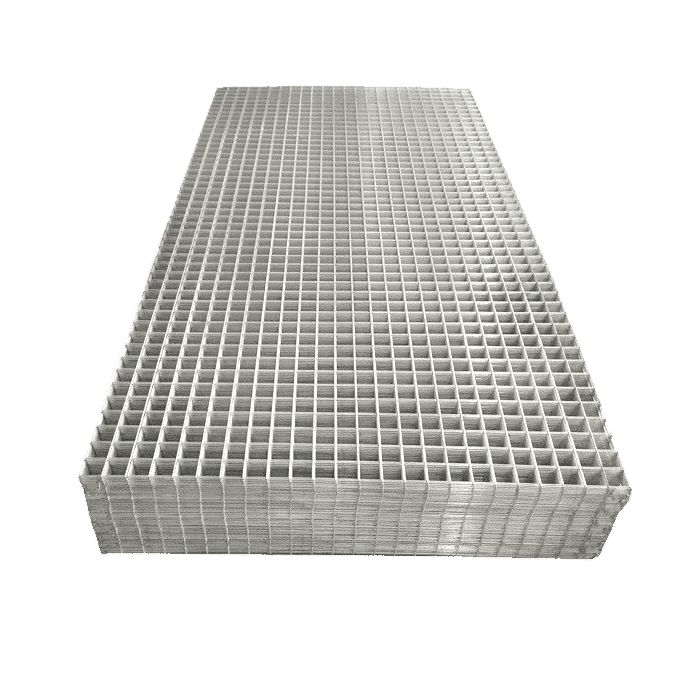
For welded mesh, manufacturers may use a wire diameter and a rectangular opening dimension to describe a product. A specification such as “2.5 mm wire, 50 × 50 mm opening” tells the manufacturer considerably more than “12-gauge mesh.”
Fine woven wire cloth is normally described differently. Buyers often specify the number of openings per inch, the wire diameter, and the weave type.
These distinctions matter because welded and woven mesh are manufactured differently and do not behave identically under load.
Wire Mesh Gauge Chart: AWG vs. SWG
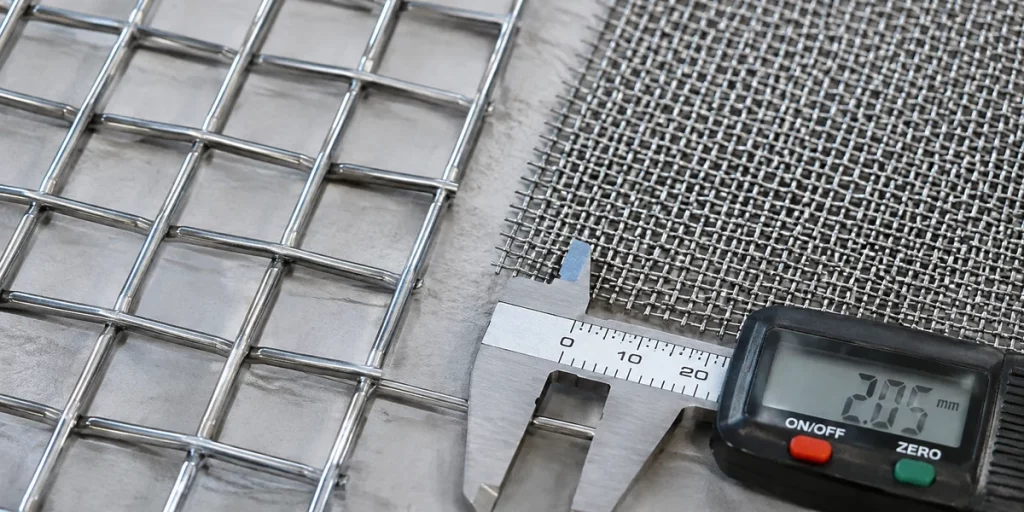
Two gauge systems appear regularly in international wire specifications. American Wire Gauge is widely used in North America, while Standard Wire Gauge originated in Britain and continues to appear in certain industrial specifications and older engineering drawings. The two systems use different diameter values.
Gauge Number | AWG Diameter (mm) | SWG Diameter (mm) |
8 | 3.264 | 4.064 |
10 | 2.588 | 3.251 |
12 | 2.053 | 2.642 |
14 | 1.628 | 2.032 |
16 | 1.291 | 1.626 |
18 | 1.024 | 1.219 |
20 | 0.812 | 0.914 |
22 | 0.644 | 0.711 |
24 | 0.511 | 0.559 |
Note: The figures are nominal gauge conversions, not guaranteed manufacturing dimensions. Actual wire diameter, available sizes, and tolerances should be confirmed with the supplier.
Consider 16 gauge. In AWG, the nominal diameter is 1.291 mm. In SWG, it is 1.626 mm, which is close to the diameter of 14 AWG wire.
That is a substantial difference for what appears to be the same gauge number.
In practice, many wire mesh manufacturers prefer to work in millimeters. An inquiry that says “1.6 mm stainless steel wire” leaves less room for interpretation than one that simply says “16 gauge.”
The distinction becomes even more important when a product drawing is prepared in one country and manufactured in another.
How Much Difference Does Wire Thickness Actually Make?
A small change in wire diameter can produce a much larger change in the amount of steel used.
Take two round carbon steel wires: one 10 AWG and one 12 AWG. Their nominal diameters are 2.588 mm and 2.053 mm, respectively.
The cross-sectional area of a round wire is calculated as: A = πd² / 4, where A is cross-sectional area and d is wire diameter.
For 10 AWG wire, the area is approximately 5.26 mm². For 12 AWG, it is about 3.31 mm².
The 10 AWG wire therefore contains roughly 59% more metal per unit length than the 12 AWG wire, assuming both are solid round wires.
Using a steel density of approximately 7,850 kg/m³, the theoretical straight-wire masses are:
Wire Size | Diameter | Approx. Mass per 100 m |
10 AWG | 2.588 mm | 4.13 kg |
12 AWG | 2.053 mm | 2.60 kg |
14 AWG | 1.628 mm | 1.63 kg |
16 AWG | 1.291 mm | 1.03 kg |
These are calculated masses of straight, uncoated, solid steel wire. They are not finished mesh weights.
A manufacturer producing thousands of welded panels must account for this difference. The amount of wire, panel dimensions, production losses, surface coating, and packaging all contribute to the final cost.
Thicker wire also offers greater resistance to bending under otherwise comparable conditions. That does not mean a 10-gauge mesh panel will always be stronger than a 12-gauge panel.
A closely spaced mesh supported by a rigid frame may perform differently from a thick-wire mesh with large openings and little support. Weld quality, steel grade, panel span, and loading direction also need to be considered.
10, 12, 14 and 16 Gauge Wire Mesh Compared
These four gauges are useful reference points for understanding how wire thickness changes a mesh product. They are not the full range of available wire sizes, and their suitability depends on the actual product design.
10 Gauge: When a Thicker Wire Is Needed
At 2.588 mm under AWG, 10-gauge wire is relatively thick compared with many light-duty mesh products.
It may be considered for welded wire panels, industrial barriers, reinforced partitions, and some protective enclosures where resistance to bending and mechanical damage matters.
Weight is an important consideration. A large panel made with this wire can be noticeably heavier than one with thinner wires at the same spacing. That affects handling, transport, installation, and potentially the supporting frame.
Thicker wire also requires suitable manufacturing equipment. Cutting, bending, and resistance welding become more demanding as the wire diameter increases.
For a machine guard, however, thickness alone is not sufficient. The guard must be assessed against the relevant safety requirements, including opening dimensions, mounting, and the hazards involved.
12 Gauge: Comparing Material Use with Rigidity
A change from 10 AWG to 12 AWG reduces the nominal wire diameter from 2.588 mm to 2.053 mm.
For the same total length of solid steel wire, that represents a theoretical mass reduction of approximately 37%.
This difference becomes relevant when a buyer is comparing welded mesh alternatives for fencing, equipment enclosures, or general industrial partitions.
The thinner wire can reduce material consumption. Whether the panel remains sufficiently rigid depends on how far the wires are spaced apart and how the mesh is supported.
A 12-gauge mesh with relatively small openings may be suitable for a particular installation, while the same wire used with much larger openings may not provide the required stiffness.
The opening dimensions should therefore be reviewed together with the wire diameter, rather than selected afterward.
14 Gauge: A Practical Thickness for Lighter Panels
Under AWG, 14-gauge wire has a nominal diameter of 1.628 mm.
It can be considered for various lighter-duty welded mesh products, including garden barriers, partitions, protective covers, and some fabricated wire components.
Suppose a buyer is choosing between 12 AWG and 14 AWG for a non-structural enclosure. At equal total wire length, 14 AWG contains about 37% less metal than 12 AWG. That reduction may be attractive where weight and material cost matter.
But the thinner wire will also be less resistant to bending in an otherwise identical arrangement.
Another factor is corrosion protection. For an outdoor product, the choice between untreated carbon steel, galvanized steel, and stainless steel may have more influence on service life than a modest increase in wire thickness.
Wire diameter and material selection should be evaluated together.
16 Gauge: Lighter Wire, Different Design Considerations
16 AWG measures approximately 1.291 mm in diameter.
Wire of this size may be used in suitable lightweight mesh constructions, ventilation guards, small enclosures, decorative components, and other fabricated products.
It is generally easier to form than thicker wire of the same material.
The trade-off becomes apparent when the distance between wires increases. A thin wire supported at wide intervals can deflect considerably under pressure.
For this reason, it is difficult to recommend 16-gauge wire without knowing the opening dimensions and how the finished mesh will be installed.
It is also worth distinguishing light welded mesh from fine woven screening. A mesh made for filtering particles or preventing insects from passing through may require much smaller apertures and finer wire than 16 AWG.
What About 18, 20 and Finer Gauges?
Higher gauge numbers describe progressively thinner wires within the same gauge system.
At 20 AWG, the nominal wire diameter is only 0.812 mm. At 24 AWG, it falls to 0.511 mm.
Finer wires can be useful where low weight, smaller mesh openings, and flexibility are needed. However, fine industrial filtration cloth is not usually selected from gauge alone.
A specification such as “100 mesh, 0.10 mm wire diameter, stainless steel 316” is much more informative for discussing a woven filtration product.
In some precision screening applications, the aperture tolerance and weave construction may be more important than the gauge number.
Wire Gauge Is Not the Same as Mesh Count
This is one of the most frequent sources of confusion in wire mesh specifications.
A buyer asks for 20-mesh wire cloth. Another asks for 20-gauge wire mesh. They are describing two different things.
20 gauge refers to a wire diameter under a particular gauge system. 20 mesh refers to the density of a woven mesh, conventionally described by the number of openings per linear inch.
The wire diameter and mesh count together determine the nominal opening size of a regular square woven mesh.
For instance, two woven screens might both be described as 20 mesh. If one uses 0.30 mm wire and the other uses 0.50 mm wire, their clear openings will not be the same. The thicker wire occupies more space between the openings.
For welded wire mesh, dimensions are often communicated directly: wire diameter 2.0 mm; opening 50 × 50 mm; panel size 1,200 × 2,400 mm.
For woven wire cloth, a buyer might instead request: mesh count 20 × 20; wire diameter 0.40 mm; weave plain weave; material stainless steel 304.
Both formats can describe wire mesh, but they reflect different product types and manufacturing requirements.
Calculating Wire Mesh Opening Size
When a woven mesh has regularly spaced square openings, the nominal aperture can be calculated from the mesh count and wire diameter.
First calculate the pitch, or center-to-center distance between adjacent wires: Pitch (mm) = 25.4 ÷ Mesh Count.
Then subtract the wire diameter: Opening (mm) = Pitch − Wire Diameter.
Consider a 20-mesh plain woven screen using 0.40 mm wire. Pitch: 25.4 ÷ 20 = 1.27 mm. Clear opening: 1.27 − 0.40 = 0.87 mm.
The nominal opening is therefore 0.87 mm, or 870 microns.
Now consider the same 20-mesh count using 0.50 mm wire. Its nominal opening decreases to 0.77 mm.
The mesh count has not changed, yet the opening is 0.10 mm smaller. For industrial screening, that difference can influence which particles pass through the mesh.
Calculating Open Area
Open area describes the percentage of the mesh surface available for passage.
For a regular square woven mesh with equal wire diameters and pitch in both directions: Open Area (%) = (Opening ÷ Pitch)² × 100.
For the 20-mesh screen with 0.40 mm wire: Open Area = (0.87 ÷ 1.27)² × 100 ≈ 46.9%.
With 0.50 mm wire, the nominal open area decreases to about 36.8%.
This illustrates why changing the wire diameter can affect screening and flow characteristics even when the mesh count stays the same.
These are nominal geometric calculations. Actual filtration performance depends on the weave, dimensional tolerances, fluid properties, pressure conditions, and particles involved.
Special weaves, including Dutch weave constructions, cannot be evaluated using the same simple square-opening calculation.
Choosing Wire Diameter for Different Applications
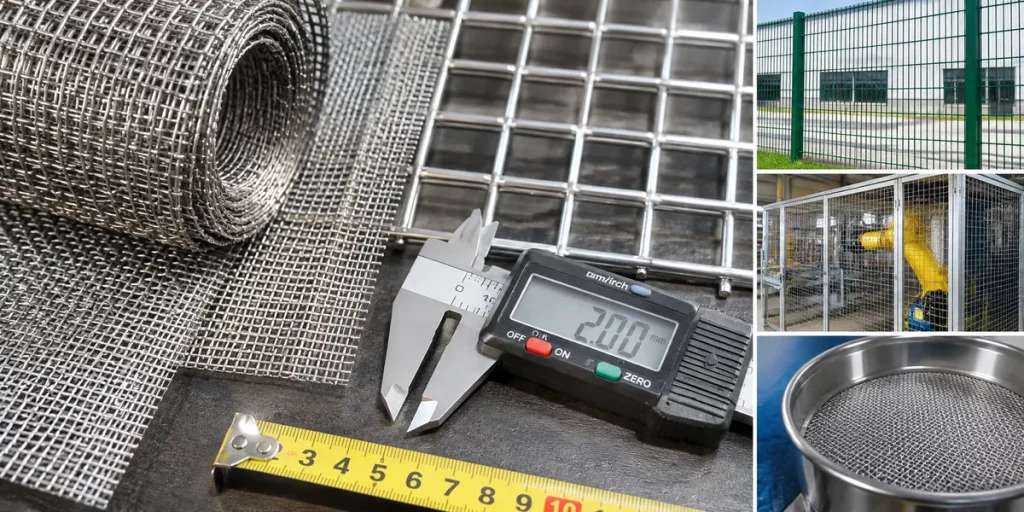
There is no universally correct wire gauge for fencing, screening, machine protection, or industrial equipment. Start with what the finished mesh must do.
Industrial Fencing and Partitions
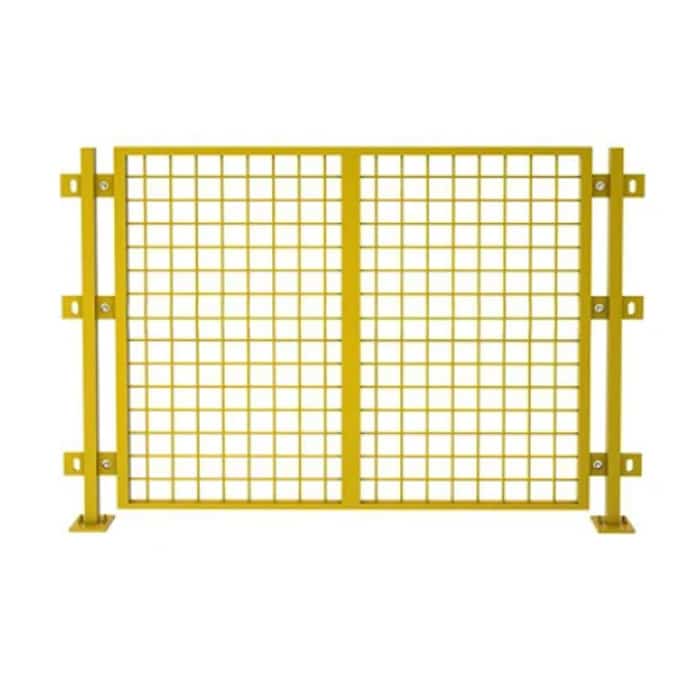
For welded mesh fencing, the wire diameter needs to be considered alongside the panel span, mesh opening, frame arrangement, and installation conditions.
A thick wire may be desirable where greater rigidity is needed. But a large unsupported panel can still deform under load.
Where corrosion is a concern, specify the coating or steel grade rather than assuming greater wire thickness will solve the problem.
Machine Guards and Protective Enclosures
For machine guarding, opening dimensions and safety distances are critical.
A heavy wire alone does not make a guard safe. The mesh must be compatible with the relevant hazard and the applicable machine safety requirements.
The way the panel is mounted also matters. A rigid mesh attached to inadequate supports may fail to provide the necessary protection.
Industrial Screening and Filtration
In screening applications, begin with the required particle separation or aperture size.
Wire diameter then becomes part of the balance between opening size, screen durability, and available open area.
Finer wire may provide greater open area at a given mesh count, although it can also be more vulnerable to wear or mechanical damage.
Abrasive materials, operating pressure, cleaning methods, and maintenance intervals should be considered before choosing the mesh.
Outdoor and Corrosive Environments
For outdoor mesh, material and surface treatment deserve particular attention.
Galvanized carbon steel is used in many fencing and general-purpose industrial applications. Stainless steel may be preferred where greater corrosion resistance or cleanliness is required.
Stainless steel 304 and 316 are not interchangeable in every environment. Chloride exposure, chemical contact, and operating temperature can affect material selection.
Coating thickness, coating method, and whether wire dimensions are measured before or after coating should also be established where relevant.
What to Check Before Ordering Wire Mesh
A drawing or specification sheet saves considerable time during the quotation process. Before placing an order, confirm the following details.
Wire diameter. State the diameter in millimeters, even when a gauge number is also given.
Opening dimensions. Specify clear aperture or center-to-center spacing and make clear which one is required.
Material. Identify the steel grade or other wire material. Terms such as “stainless steel” may be too broad for technical purchasing.
Manufacturing method. State whether the product is welded, plain woven, twilled woven, or another construction.
Product dimensions. Include panel length and width, roll width and length, or the required fabricated shape.
Surface treatment. For galvanized mesh, confirm the coating specification and whether galvanizing takes place before or after welding where applicable.
Tolerances and standards. Identify the dimensional tolerances and any applicable product standard required by the project.
Quantity. Provide the number of panels or rolls, or the total area required.
For example, a welded mesh inquiry could read:
Welded wire mesh, 2.5 mm nominal carbon steel wire, 50 × 50 mm nominal clear openings, 1,200 × 2,400 mm panels, galvanized finish. Please confirm material grade, wire diameter tolerance, coating specification, available panel sizes, and quotation for 500 panels.
For square-aperture industrial woven wire cloth, ISO 9044:2016 provides relevant technical requirements and test methods. The standard does not apply to all mesh products, including welded wire screens.
A supplier should be asked to confirm the relevant standard for the actual product being manufactured.
Frequently Asked Questions
Is 10-gauge wire mesh thicker than 12-gauge?
Yes, when the same gauge system is used. Under AWG, 10-gauge wire is 2.588 mm in diameter, compared with 2.053 mm for 12-gauge wire.
What is the diameter of 16-gauge wire mesh?
16 AWG has a nominal wire diameter of 1.291 mm. Under SWG, 16 gauge measures approximately 1.626 mm. Always establish which gauge system the supplier uses.
Does a higher wire gauge mean smaller mesh openings?
Not necessarily. A higher gauge number means thinner wire within the same gauge system. The opening size also depends on wire spacing or mesh count.
What gauge wire is used for welded wire mesh?
Welded wire mesh can be produced from many wire diameters. Suitable sizes depend on the application, welding equipment, product design, and performance requirements. Rather than choosing from gauge alone, provide the intended wire diameter and opening dimensions.
How is wire mesh measured?
A complete specification typically includes wire diameter, opening dimensions or mesh count, material, construction method, and finished size. For square woven mesh, nominal clear aperture can be calculated from pitch minus wire diameter.
Are AWG and SWG interchangeable?
No. The same gauge number represents different wire diameters in the two systems. Dimensions in millimeters should be used to confirm the requirement.
Final Notes on Wire Mesh Gauge Selection
Before approving a mesh specification, check the wire diameter, opening dimensions, and material. Then review how the finished product will be installed and what loads or environmental conditions it may encounter.
A gauge number is useful as a quick reference, but it is not a complete technical specification.
For international orders, writing the actual wire diameter in millimeters is a simple way to avoid misunderstandings between different gauge systems.
If you are sourcing welded wire mesh for an industrial project, SUNJ GRATING can be contacted through chinagratings.com to discuss drawings, required dimensions, surface treatments, and quotation details.
The more clearly those requirements are defined at the inquiry stage, the easier it becomes to compare quotations and verify the product before production.
Related Post might be HELPFUL to you: Advantages and Disadvantages of Wire Fencing

 English
 Spanish
 Portuguese
 German
 French
 Italian
 Japanese
 Korean
 Russian