
Table of Contents
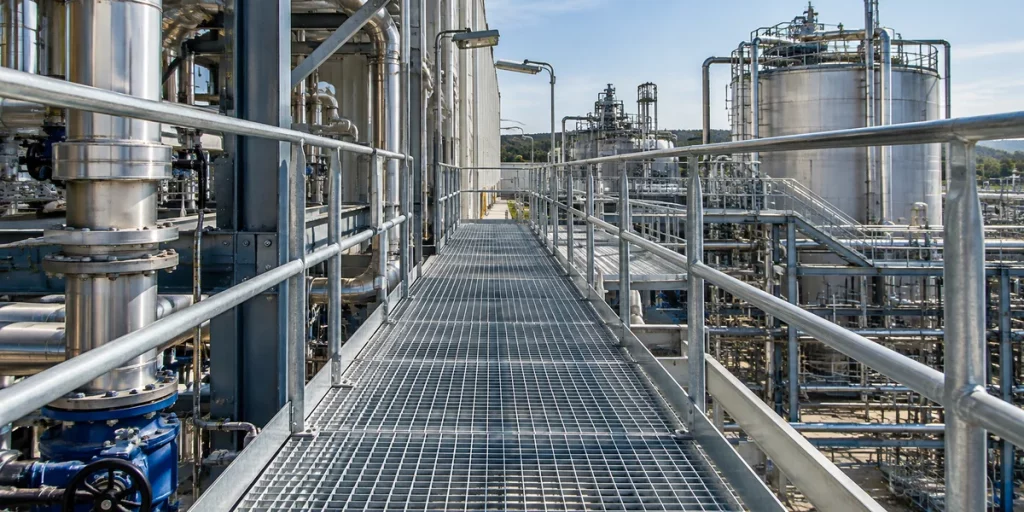
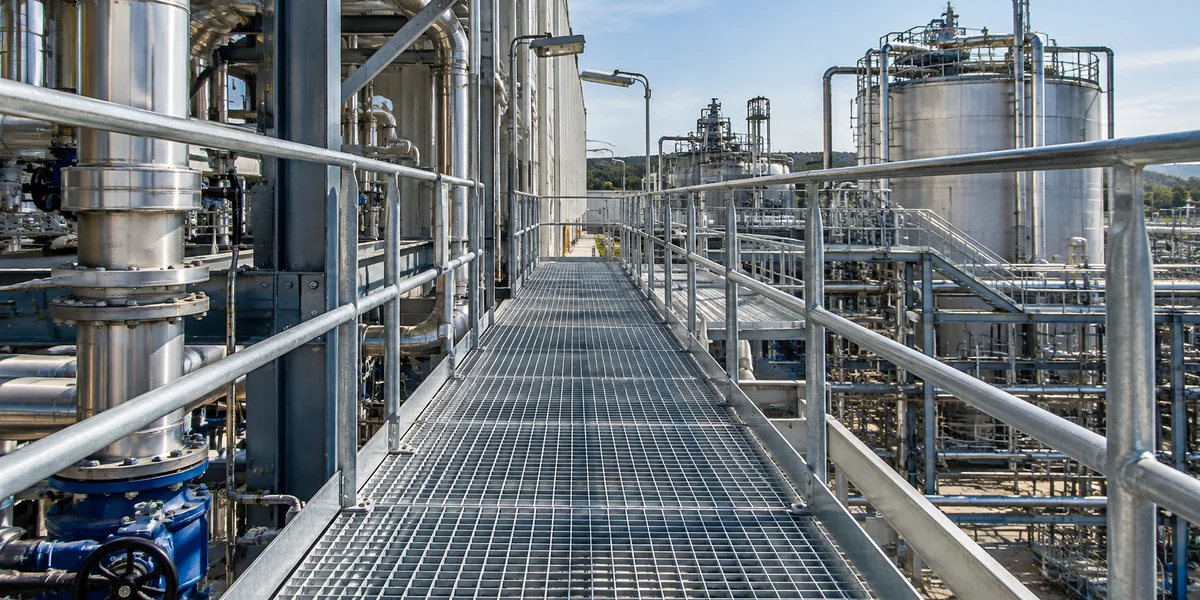
Walk across a steel grating platform in a wastewater treatment plant and one feature becomes immediately apparent: there is no solid floor beneath your feet. Water drains between the bars, and much of the supporting structure remains visible.
Now picture the same open-grid flooring on a pedestrian bridge outside a shopping center. The drainage might still be useful, but wide openings could create problems for people wearing narrow heels or using mobility aids.
The material hasn’t changed. The demands placed on it have.
This is what makes walkway grating selection more complicated than choosing a panel from a catalog. A grating that works well around industrial machinery may be unsuitable for a public walkway, even if the two installations cover roughly the same area.
The following sections look at where walkway gratings are used, how their construction affects performance, and which details deserve attention before an order reaches the factory.
What Is Walkway Grating?
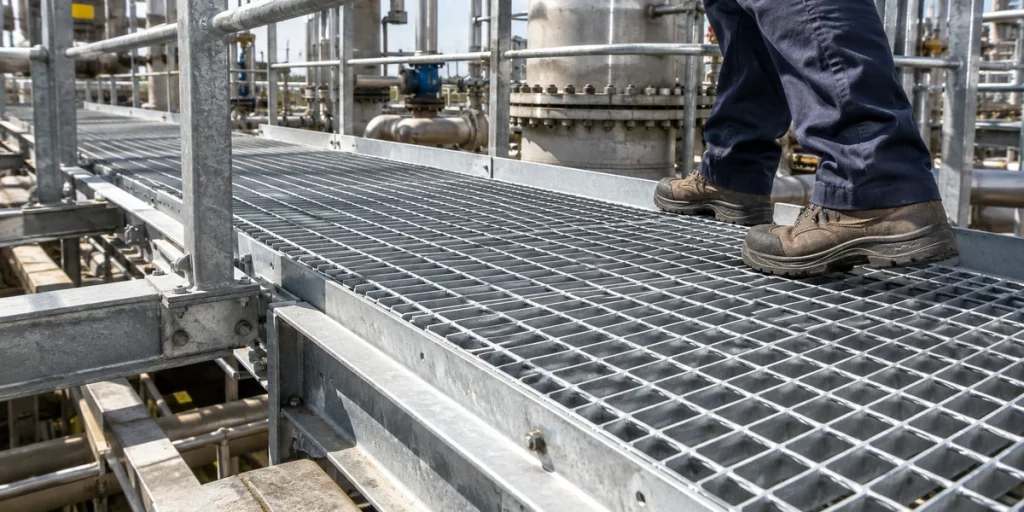
Walkway grating is open-grid flooring made from metal bars or other structural materials. It creates a walking surface while leaving spaces for water, air, light, and sometimes debris to pass through.
In conventional steel bar grating, the main load-carrying members are called bearing bars. Cross bars connect these members and keep them correctly spaced.
The distinction matters. Bearing bars transfer pedestrian and equipment loads to the supporting structure. Cross bars help stabilize the assembly but do not ordinarily replace the primary load path.
Steel walkway grating is commonly available in welded and press-locked constructions. Plain-top and serrated bearing bars offer different surface characteristics.
Galvanized carbon steel is widely considered for outdoor industrial platforms. Stainless steel is used where the environment justifies its corrosion resistance, while aluminum can be useful in projects where reducing structural weight is important.
Those material descriptions are only a starting point. A complete walkway specification must also account for load capacity, span, opening size, and the way the panels are fixed.
Where Are Walkway Gratings Commonly Used?
Industrial Maintenance Platforms
An elevated maintenance platform usually exists for a practical reason: somebody needs to reach equipment that cannot be serviced from ground level.
Factories use steel grating walkways around processing machines, overhead pipework, conveyors, and other installations. The open floor can provide access without fully enclosing the space below.
But maintenance work does not always involve a single person carrying a small tool bag.
Consider a platform normally used for visual inspections. During equipment servicing, workers may need to carry replacement components or position heavy tools temporarily on the floor.
If those activities were not considered during design, the original walkway loading assumptions may no longer be adequate.
This is also where panel layout becomes important. A removable grating section may provide access to a valve or machine component, but it needs appropriate restraints during normal service and safe procedures when removed.
For factory platforms, the key question is not simply whether the grating can carry people. It is what activities will take place on the platform throughout its service life.
Power Plants and Energy Facilities
Walkways at power stations often run alongside boilers, turbines, piping systems, and elevated equipment.
A typical installation may include long access routes interrupted by structural frames, equipment penetrations, and changes in elevation.
Bearing bar orientation becomes particularly important in these layouts.
A rectangular grating panel may be manufactured to the correct external dimensions and still be installed incorrectly if its bearing bars do not span between the intended supports.
The panel might fit the opening perfectly while transferring loads in a way the designer never intended.
For this reason, engineering drawings should identify the bearing bar direction rather than showing only panel length and width.
Power facilities can also introduce temperature variations, vibration, and maintenance access requirements. These factors influence support details, fixing arrangements, and the inspection program.
Open grating may reduce unnecessary floor weight and allow air movement around equipment, but the structural framework must still be designed for all applicable loads.
Oil, Gas and Petrochemical Plants
A dry, clean industrial walkway and one exposed to oil, process fluids, and aggressive atmospheric conditions present different challenges.
In petrochemical facilities, the grating surface may be exposed to occasional spills, standing moisture, or chemical residues.
Serrated bearing bars are sometimes specified to provide additional surface traction. They should not, however, be treated as a guarantee against slipping.
Oil contamination can make many walking surfaces hazardous, regardless of the pattern machined into the metal.
Material selection is equally important.
Hot-dip galvanized carbon steel is used in a wide range of industrial installations, but the zinc coating has limitations in certain chemical environments. Stainless steel may be considered where greater corrosion resistance is needed, provided the selected grade is compatible with the actual exposure.
Another issue is the space below elevated walkways.
Open grids allow objects smaller than the openings to fall through. Where people or sensitive equipment are positioned underneath, protective screening, smaller apertures, toeboards, or other containment measures may be necessary.
These details are part of the walkway design, not optional accessories to consider after installation.
Wastewater Treatment Facilities
Water treatment plants are particularly demanding places for walkway flooring.
Operators regularly move between tanks, pumps, valves, aeration equipment, and chemical treatment systems. Many of these areas remain damp for long periods.
Open grating helps water pass through the floor instead of collecting across the entire walking surface.
That advantage is straightforward. Material selection is less so.
A galvanized steel walkway near a relatively mild water treatment process may perform differently from one exposed to aggressive chemical dosing, chloride-containing solutions, or frequent washdowns.
Stainless steel is another option, but selecting between grades such as 304 and 316 still requires an understanding of the environment.
Where corrosion is a major concern, engineers may also evaluate nonmetallic grating systems. The decision must account for structural behavior, fire performance, operating temperature, and other project requirements.
Rather than asking which material is generally best for wastewater treatment, it is more useful to identify what substances contact the walkway, how often the surface is wet, and what inspection access will be available.
Warehouse and Mezzanine Walkways
Warehouses use grating for access platforms, maintenance routes, equipment mezzanines, and certain elevated service areas.
An open-grid floor can reduce the dead weight of a platform and allow visibility between levels.
Problems arise when the intended use changes.
Suppose a mezzanine is originally designated for occasional pedestrian access. Later, staff begin placing spare components or storage containers on it.
The loads have changed, even though the grating itself looks exactly the same.
Concentrated loads deserve particular attention. A narrow equipment wheel or small support foot places force over a much smaller contact area than an evenly distributed pedestrian load.
A grating suitable for walking may therefore be unsuitable for trolleys, pallet-handling equipment, or heavy machinery.
Wheel orientation, contact dimensions, and potential impact loading should be reviewed before such equipment is permitted to use the surface.
Public and Architectural Walkways
Public walkway projects bring another set of considerations.
In industrial facilities, users may wear specified safety footwear and receive training. Public spaces must accommodate a much broader range of people.
A grating pattern that works well on a restricted maintenance platform may cause difficulties for wheelchair users, walking aids, or narrow footwear.
Opening dimensions and direction are therefore important.
Outdoor architectural walkways may benefit from the drainage provided by an open surface. Press-locked grating can also be selected for its regular visual pattern.
But designers have to consider more than appearance.
Walking comfort, accessibility, noise, surface traction, falling-object hazards, and maintenance all influence whether a particular grating type is appropriate.
In some public applications, a smaller-opening product or a continuous deck may be a better choice.
Steel Grating or Solid Floor Plate?
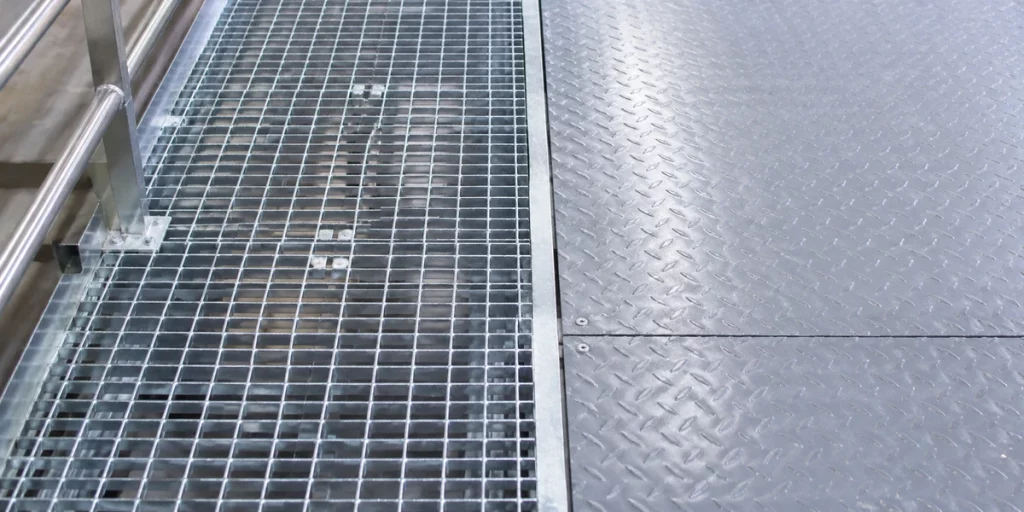
Open grating is not automatically superior to steel plate or concrete flooring.
The materials solve different problems.
For a wet industrial platform, an open grid allows liquid to pass through. A solid plate generally requires a separate drainage arrangement to prevent water from collecting on its surface.
On the other hand, a solid floor is better suited to situations where small objects must be contained or where the use of wheeled equipment demands a continuous surface.
Weight can also influence the decision. Depending on the structural design, an open grating floor may impose a lower dead load than a solid plate system.
That benefit needs to be checked against the selected bar dimensions and loading requirements.
Design Issue | Open Steel Grating | Solid Steel Plate |
Drainage | Water can pass through openings | Requires suitable drainage arrangements |
Ventilation | Permits airflow through the floor | Blocks vertical airflow |
Small objects | May fall through openings | Generally retained on the surface |
Wheeled equipment | Depends heavily on opening and wheel dimensions | Usually provides more continuous support |
Visibility below | Generally possible | Obstructed |
Maintenance access | Removable panels can provide access | Requires suitable access panels or openings |
Surface traction | Depends on bar profile and conditions | Depends on plate finish and conditions |
Neither option eliminates the need to assess loading, slip hazards, corrosion, or maintenance.
A project with oily machinery and frequent washdowns may favor an open surface for drainage. A workspace handling small precision components may need a more continuous floor.
The correct choice follows the work taking place above and below the walkway.
What Determines Walkway Grating Load Capacity?
One of the most common mistakes in grating purchasing is selecting panels by external dimensions alone.
A drawing may state that a panel needs to be 1,000 × 1,200 mm. That tells the factory how much area it must cover. It does not establish how much weight the panel can safely carry.
For a metal bar grating, the principal structural variables include:
- Bearing bar depth and thickness
- Spacing between bearing bars
- Clear span between structural supports
- Material mechanical properties
- Uniformly distributed and concentrated loads
- Allowable stress and deflection
- Support and fixing conditions
Consider two otherwise identical panels.
One spans 600 mm between supports. The other spans 1,000 mm.
Under simplified beam theory, with identical stiffness and equal uniformly distributed load per unit length, the maximum deflection of a simply supported member is proportional to the fourth power of its span.
Deflection ratio = (1,000 / 600)⁴ ≈ 7.72
In that idealized comparison, the longer member would deflect about 7.7 times as much.
This is not a prediction of the actual deflection of a particular grating panel. Real grating behavior also involves load distribution, connection geometry, end support, and other engineering considerations.
It does illustrate why the distance between supports deserves attention early in the design process.
A thicker bearing bar may improve performance, but that does not mean an engineer can ignore the span or the loading arrangement.
Manufacturer load tables are intended to help make these comparisons. For North American metal bar grating, ANSI/NAAMM MBG 531-24 provides technical specifications, loading information, and typical installation details.
The selected product should be checked against the project requirements rather than chosen by visual resemblance to an existing walkway.
Bearing Bar Direction
There is another detail worth checking on every grating drawing: the direction of the bearing bars.
These members must span across the structural supports in the manner assumed by the design.
If a rectangular panel is rotated, the bearing bars may no longer follow the intended load path.
Panel dimensions alone cannot establish correct orientation.
For custom walkways, drawings should identify both bearing bar direction and support locations.
Selecting Materials and Surface Finishes
Once load and span requirements have been established, the material and surface treatment can be evaluated.
For general industrial use, carbon steel grating with hot-dip galvanizing is a common specification.
Galvanizing applies a protective zinc coating that helps reduce corrosion of the underlying steel. Its useful life depends on coating characteristics and environmental exposure.
The coating does not make the grating permanently rustproof.
Stainless steel may be appropriate where environmental conditions, cleanliness, or corrosion exposure justify the additional material cost.
Aluminum is lighter than carbon steel, although its mechanical properties differ. Aluminum grating must be sized for the relevant loads and deflection limits rather than substituted directly for steel.
The table below provides a starting comparison.
Material | Main Advantage | What to Check |
Hot-dip galvanized carbon steel | Structural performance and corrosion protection for many industrial conditions | Coating specification, chemical exposure, maintenance requirements |
Stainless steel 304 | Corrosion resistance and cleanable surface | Chloride and chemical exposure |
Stainless steel 316 | Improved resistance in certain corrosive environments | Actual chemical conditions and operating temperature |
Aluminum | Low material density | Structural stiffness, loading, compatibility with the environment |
Surface profile is a separate decision.
Plain bearing bars may be appropriate for some dry or controlled environments. Serrated surfaces may provide additional traction under certain conditions.
Neither choice removes the need for cleaning, drainage, appropriate footwear, and site-specific slip-risk assessment.
Installation and Maintenance Problems Worth Preventing
Many walkway problems are not caused by choosing the wrong material. They begin with missing installation details or changes made after construction.
A panel that has insufficient bearing support can move or deform under load. A missing fixing clip may allow a removable panel to shift.
Modifications can also create problems. When new pipework or equipment is installed, workers may cut additional openings through existing grating.
If bearing bars are removed without proper engineering review, the panel’s load path can be altered.
That is why cutouts, edge reinforcement, supports, and fastening details should be agreed before fabrication whenever possible.
Installation inspections should confirm that the grating matches the approved drawings, bears correctly on its supports, and is secured using the specified fastening arrangement.
Maintenance becomes a matter of looking for changes.
A panel that moves underfoot, a corroded support connection, or a permanently bent bearing bar deserves investigation. Debris blocking drainage should also be removed before it creates persistent wet areas or other hazards.
After equipment replacement, changes to storage practices, or structural alterations, the intended walkway loading should be reviewed again.
In the United States, OSHA 29 CFR 1910.22 requires workplace walking-working surfaces to support their maximum intended loads and to be inspected and maintained in safe condition. Other jurisdictions have their own applicable requirements.
Any repair affecting structural integrity should be handled by appropriately qualified personnel.
What Should Be Included in a Walkway Grating RFQ?
Manufacturers can quote more accurately when the inquiry includes the engineering details rather than only the total project area.
A buyer requesting “200 square meters of galvanized walkway grating” has provided a useful quantity, but not enough information to establish a suitable design or price.
For an industrial walkway project, a practical request for quotation should include the following.
Item | Information to Provide |
Application | Maintenance platform, access walkway, mezzanine or pedestrian bridge |
Material | Carbon steel, stainless steel or aluminum |
Grating construction | Welded or press-locked |
Bearing bar | Proposed depth and thickness, if known |
Bar spacing | Bearing bar and cross bar spacing |
Panel size | Dimensions or fabrication drawings |
Clear span | Distance between structural supports |
Loading | Uniform, concentrated and other applicable design loads |
Finish | Galvanized, untreated or other specified finish |
Surface | Plain or serrated |
Installation | Fixing method, support details and special cutouts |
Quantity | Panel count, total area and project delivery requirements |
Where the project engineer has not yet selected the bearing bar dimensions, the load and span data become especially important.
For example, an inquiry might state:
“We require hot-dip galvanized welded steel grating for an elevated maintenance platform. The drawings show a clear support span of 900 mm. Please review the specified loading requirements and propose a suitable bearing bar configuration. The quotation should include panel dimensions, bearing bar direction, fixing accessories, and relevant manufacturing tolerances.”
This gives a manufacturer a much better starting point than a request based on panel size alone.
It also separates the tasks correctly: engineering requirements come first, followed by product selection and fabrication.
Frequently Asked Questions
Where is walkway grating most commonly used?
Typical applications include factory maintenance platforms, power plants, chemical facilities, wastewater treatment plants, elevated access routes, and selected public walkways. The required construction varies with loading, environment, and pedestrian use.
Is galvanized walkway grating suitable for outdoor use?
Hot-dip galvanized steel is used in many outdoor industrial applications. Its suitability depends on the coating specification, corrosion exposure, and expected maintenance conditions.
Can walkway grating support heavy equipment?
Only when the grating and its supports have been designed and verified for those loads. Equipment wheels and support feet can produce concentrated loads that differ substantially from normal pedestrian traffic.
Is serrated grating always safer than plain grating?
Not in every condition. Serrations may improve traction in some situations, but liquids, contamination, footwear, and cleaning practices also influence slip risk.
What information is needed to calculate grating load capacity?
At minimum, the calculation requires the bearing bar dimensions, spacing, support span, material properties, load conditions, and allowable performance criteria. Manufacturer load tables and project-specific engineering checks should be used where appropriate.
Before Sending the Drawings to the Factory
A walkway panel can have the correct outside dimensions and still be wrong for the project.
The bearing bars might run in the wrong direction. The support span may differ from the drawing. A loading requirement or opening around a pipe may have been omitted.
These are much easier problems to resolve before fabrication.
For a new walkway project, start by checking the loading, support layout, bearing bar direction, environment, and installation details. Once those are established, the grating size, material, finish, and fixing arrangement can be specified more confidently.
Related Post might be HELPFUL to you: Steel Grating
 English
 Spanish
 Portuguese
 German
 French
 Italian
 Japanese
 Korean
 Russian