


Table of Contents
Common Types of Steel Grating
Welded Steel Grating
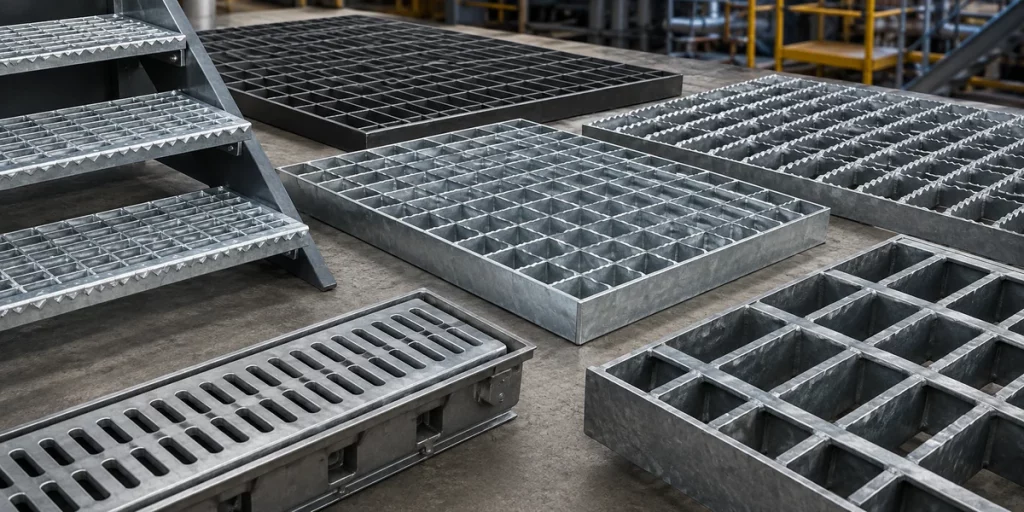
Welded grating is produced by positioning cross bars across parallel bearing bars and joining them under pressure. The bearing bars carry the main load, while the cross bars maintain spacing and provide lateral stability.
This structure is commonly used for:
- Factory platforms
- Maintenance walkways
- Power plants
- Mining facilities
- Petrochemical projects
- Mezzanines
- Equipment access floors
- Drainage systems
For general industrial flooring, welded carbon steel grating is often the most practical solution. It is strong, relatively economical and easy to fabricate into different panel shapes.
Still, “standard welded grating” is not a complete specification. The load direction, clear span and bearing-bar dimensions must also be confirmed.
Hot-Dip Galvanized Steel Grating
Most carbon steel grating used outdoors is hot-dip galvanized after welding and fabrication. The completed panels are cleaned and immersed in molten zinc, creating a protective coating over the steel surfaces and welded areas.
Galvanized grating is commonly used in outdoor plants, drainage systems, wastewater facilities, ports, warehouses and municipal projects.
In our experience, buyers sometimes request galvanized full-size sheets and plan to make all openings on site. This looks flexible at first, but every cut removes the zinc coating and creates an exposed steel edge that must be repaired.
When the drawings are available, it is usually better to complete major cutouts, banding and welding before galvanizing.
Serrated Steel Grating
Serrated grating has notches formed along the top edge of the bearing bars. The uneven surface provides additional contact with footwear and is often selected for wet, oily or exposed working areas.
It is suitable for:
- Wastewater plants
- Marine platforms
- Outdoor stairs
- Processing facilities
- Wash-down areas
- Oily maintenance floors
Serrated bars are useful, but we do not recommend them automatically for every project.
For a dry indoor platform, plain grating is usually easier to clean and more comfortable for workers moving small carts. Serrated grating may add cost without solving a real problem.
The surface should match the environment.
Stainless Steel Grating
Stainless steel grating is used where corrosion resistance, hygiene or appearance is more demanding than normal industrial service.
Typical applications include food-processing plants, chemical areas, commercial kitchens, water-treatment equipment, coastal facilities and architectural projects.
Grades such as 304 and 316 may be considered, but the correct selection depends on the actual environment. Chlorides, cleaning chemicals, operating temperature and contact with other metals all affect stainless steel performance.
Stainless steel is not always the best choice simply because it costs more. For many outdoor utility platforms, properly galvanized carbon steel offers a more economical solution.
Heavy-Duty Steel Grating
Heavy-duty grating is manufactured with deeper, thicker or more closely spaced bearing bars. It is intended for concentrated loads, vehicle traffic, heavy equipment or large support spans.
This type of grating may be used for:
- Truck and forklift areas
- Loading zones
- Industrial trenches
- Port facilities
- Heavy equipment platforms
- Vehicle drainage channels
Pedestrian grating and vehicle grating should never be treated as interchangeable products.
A vehicle wheel applies a concentrated load to a relatively small area. Even when a panel looks heavy, it still needs to be checked against the wheel load, clear span and frame design.
Steel Grating Stair Treads
Steel grating stair treads can be fabricated with mounting side plates and a reinforced front edge. The nosing may be made from checker plate, perforated plate or another slip-resistant material.
The stair width, tread depth, support position and fixing-hole arrangement should be shown on the drawing before production.
Gate and stair components often cause more installation problems than ordinary rectangular panels because even a small hole-position error becomes immediately visible on site.
Steel Grating Specifications
The following table shows common specification options. Final availability and structural selection should be confirmed according to project requirements.
Item | Available options |
Material | Carbon steel, galvanized carbon steel, stainless steel |
Bearing-bar surface | Plain or serrated |
Bearing-bar form | Flat bar or project-specified profile |
Bearing-bar spacing | Standard or customized spacing |
Cross-bar spacing | Standard or customized spacing |
Surface treatment | Untreated, painted or hot-dip galvanized |
Panel shape | Rectangular, circular, angled or irregular |
Edge treatment | Open edge, banded edge or toe plate |
Fabrication | Cutouts, notches, side plates, nosing and mounting holes |
Supply form | Full sheets or installation-ready panels |
Bearing-bar dimensions and spacing should not be chosen only by copying another project. A platform with a short support span may use a lighter section than a visually similar platform with a longer span.
This is one of the most common cost-estimating errors.
A customer may compare two quotations and assume the lower price represents better purchasing. Later, it becomes clear that the quotations were based on different bearing-bar depths, spacing patterns or steel weights.
Before comparing price, compare the specification line by line.
How to Choose the Right Steel Grating
Several factors should be considered together.
Start with the Support Span
The clear distance between the supporting beams has a major influence on grating performance. As the span increases, the bearing bars must resist greater bending.
A deeper bearing bar usually carries more load than a shallow bar of the same thickness. Increasing bar thickness or reducing bar spacing can also improve capacity, but these changes increase panel weight and cost.
The bearing bars must run from one support to the next.
This sounds obvious. It is not always shown clearly on drawings.
We have received grating layouts where the panel dimensions were marked but the bearing-bar direction was missing. If the panel is manufactured with the bars running the wrong way, it may have almost no useful support in the intended installation direction.
Identify the Actual Traffic
The word “platform” does not tell us enough.
Will it carry only maintenance workers? Will workers use pallet trucks? Will equipment be temporarily placed on it? Will a forklift, car or truck pass over the grating?
A practical selection guide is shown below.
Project condition | General recommendation |
Occasional pedestrian access | Standard industrial grating |
Frequent pedestrian traffic | Comfortable spacing and stable fixing |
Small-wheel trolleys | Closer spacing and a smoother surface |
Wet or oily floor | Serrated bearing bars |
Outdoor environment | Hot-dip galvanized carbon steel |
Chemical or hygienic area | Suitable stainless steel grade |
Heavy equipment | Deeper or thicker bearing bars |
Vehicle traffic | Load-rated heavy-duty grating and frame |
The final structural selection should be checked using the applicable load criteria and support arrangement.
Consider Open Area
Closer bar spacing supports smaller objects and may feel more comfortable underfoot. It also uses more steel, increases weight and reduces the amount of open area.
Wider spacing improves drainage and ventilation but may not be suitable for narrow wheels, certain footwear or areas where small objects could fall through.
There is no universally “best” spacing.
A large opening that works well on a rooftop maintenance walkway may be unacceptable on a platform where workers regularly carry bolts, tools or small components.
Custom Steel Grating Fabrication
Industrial grating is rarely installed on a perfectly empty rectangular structure. Pipes, columns, tanks, cable trays, valves and machine bases often pass through the platform.
Huade can fabricate grating with:
- Pipe openings
- Rectangular equipment cutouts
- Angled corners
- Curved edges
- Removable access panels
- Toe plates
- Edge banding
- Stair side plates
- Mounting holes
- Safety nosing
Accurate drawings are essential.
One recurring problem is the use of different dimensional reference points. A pipe opening may be positioned from the panel edge on one view, but from the platform centerline on another. Both dimensions may appear reasonable until they are checked together.
We prefer to identify these conflicts before production.
Making one more drawing revision is inconvenient. Remaking galvanized panels after delivery is far worse.
For complicated platforms, the drawing should show:
- Panel number
- Overall dimensions
- Bearing-bar direction
- Cutout dimensions and positions
- Banding or toe-plate requirements
- Support locations
- Surface finish
- Installation reference
The more irregular the panel, the less useful a simple written specification becomes.
Send the drawing.
Manufacturing Process
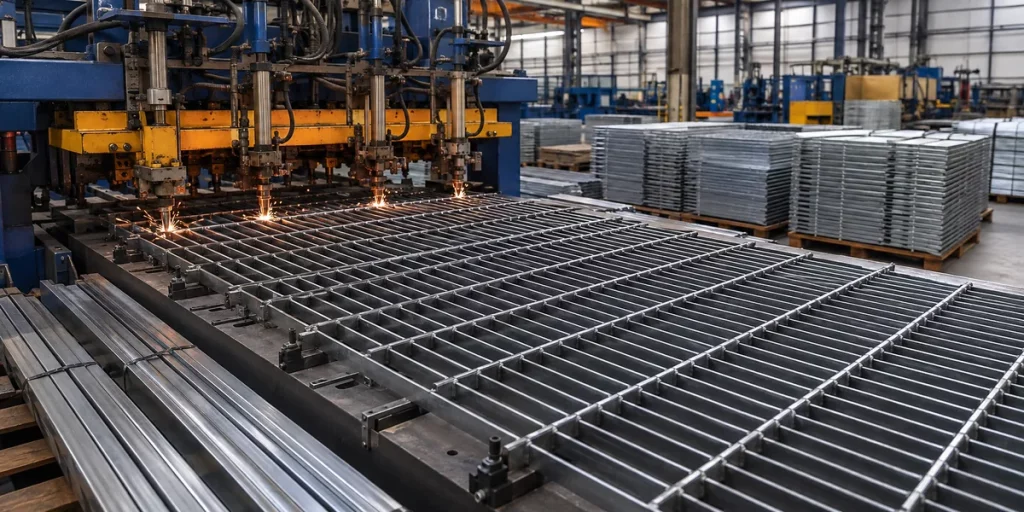
Steel grating production begins with material preparation, but the quality of the final panel depends on much more than the steel grade.
Material Inspection and Straightening
Bearing bars are checked for dimensions, straightness and surface condition. Bent or twisted material can create uneven spacing and make it difficult to produce flat panels.
Minor bar distortion may not look serious before welding. Across a large sheet, however, it can result in noticeable panel movement.
Bar Arrangement and Welding
The bearing bars are positioned at the required spacing and joined by the cross bars. Welding pressure and heat must be controlled carefully.
Insufficient welding can allow cross bars to loosen during handling or cutting. Excessive heat can distort the panel.
This balance becomes more difficult with thin bars, closely spaced grating and panels containing numerous openings.
Cutting and Fabrication
After welding, the grating is cut to size. Cutouts, curves, notches and irregular edges are then completed according to the approved drawing.
Banding bars are added where necessary. Toe plates, mounting plates or stair components are welded before surface treatment.
An irregular panel can take much longer to fabricate than a standard rectangular panel of the same weight.
That is why quotations based only on kilograms may be misleading.
Surface Treatment
Carbon steel panels may be supplied untreated, painted or hot-dip galvanized.
For galvanized products, proper drainage and venting must be considered during fabrication. Tight cavities and certain welded details may trap zinc or prevent smooth drainage during dipping.
Closely spaced and heavily fabricated panels sometimes show more zinc accumulation than open standard grating. This is not always avoidable, but good fabrication design can reduce it.
Final Inspection
Before packing, panels may be checked for:
- Length and width
- Diagonal dimensions
- Bar spacing
- Bearing-bar direction
- Panel flatness
- Cutout location
- Weld condition
- Edge fabrication
- Surface treatment
- Panel identification
For cut-to-size project orders, we also compare the panel marks with the approved drawings and packing list.
Plain, Galvanized or Stainless Steel?
Material selection should be based on the operating environment rather than habit.
Option | Main advantage | Limitation | Typical use |
Untreated carbon steel | Low initial cost | Requires protection in humid conditions | Indoor fabrication or further processing |
Painted carbon steel | Color options and basic protection | Coating requires maintenance | Indoor platforms and project-specific finishes |
Hot-dip galvanized steel | Good outdoor corrosion resistance | Cut edges require repair | Industrial platforms, drains and outdoor walkways |
Stainless steel | Strong corrosion and hygiene performance | Higher material cost | Food, chemical, coastal and architectural projects |
Galvanized steel is the most common solution for general outdoor industrial use.
Stainless steel should be selected when its additional corrosion resistance is genuinely required. Using stainless steel in a normal dry warehouse may be unnecessary; using ordinary painted steel beside a coastal chemical process may be a false economy.
Personally, we prefer to discuss the environment before discussing the finish.
Steel Grating Installation
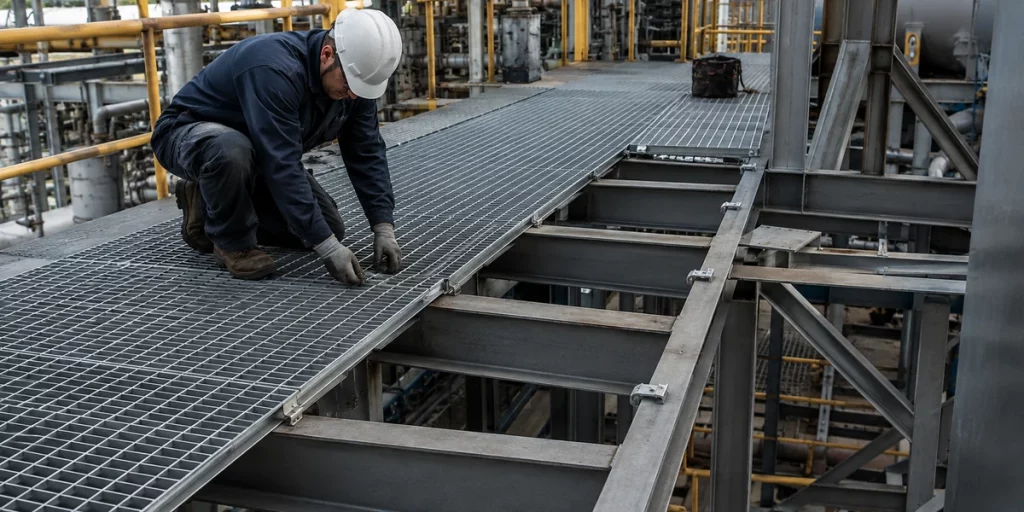
Panels may be fixed by welding, mechanical clips or project-specific fasteners.
Welding provides a permanent connection and may be suitable when the panels will not need to be removed. However, welded areas on galvanized products should be repaired after installation with an appropriate zinc-rich coating.
Mechanical grating clips allow panels to be removed for maintenance. They are commonly used over equipment, valves, drainage systems and access spaces.
Clip selection depends on the bearing bars and supporting steel. In areas exposed to vibration, mechanical fasteners should be inspected periodically.
Panels should be installed with even bearing on the supports. A panel should not be forced into an opening by striking or bending it, especially when the grating contains fabricated cutouts.
If a panel does not fit, the first question should be whether the panel is wrong—or whether the supporting structure was built differently from the drawing.
Both situations happen.
Packing and Project Identification
Standard grating sheets can usually be stacked and strapped in bundles. Customized project panels require more planning.
For large projects, Huade can organize panels according to drawing numbers or installation areas. Identification marks and packing lists help the site team find the correct panels without opening every bundle.
Protection is also required at irregular corners and fabricated edges. These areas are more vulnerable to bending during loading and transportation than the middle of a rectangular panel.
We have found that packing problems are often discovered only after the product reaches the site. A panel may be manufactured correctly but arrive with a bent toe plate or damaged corner because it was placed under heavier sheets.
Good manufacturing deserves equally careful packing.
Steel Grating Applications
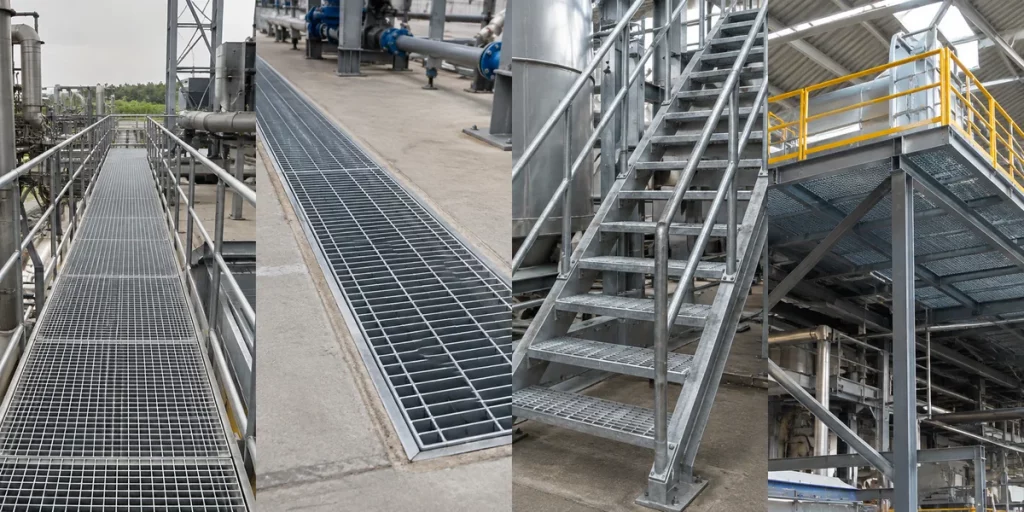
Huade steel grating can be manufactured for a wide range of industrial and infrastructure applications.
Industrial Platforms
Open grating provides ventilation, drainage and access around machinery, pipes and production equipment.
Walkways and Access Routes
Galvanized grating is widely used for elevated walkways, rooftop access and maintenance routes.
Drainage and Trench Covers
Grating allows water to enter the channel while keeping the surface accessible. The panel and supporting frame must be selected according to pedestrian or vehicle loads.
Stair Treads
Fabricated treads are suitable for industrial stairways, towers, fire escapes and equipment access.
Wastewater Facilities
Galvanized and stainless steel grating can be used around tanks, pumps and treatment equipment where drainage and corrosion resistance are required.
Mining and Material Handling
Heavy-duty or serrated grating may be installed around crushing, conveying and screening systems.
Power and Petrochemical Projects
Platforms and walkways provide access to pipes, valves, tanks and process equipment.
Architectural Applications
Carefully fabricated grating may also be used for façades, sunshades, screens, ceilings and landscape features.
Information Required for a Quotation
An accurate quotation requires more than the overall panel dimensions.
Please provide the following information where available:
Information | Example |
Material | Carbon steel or stainless steel 304 |
Bearing-bar size | 30 × 3 mm |
Bearing-bar spacing | 30 mm |
Cross-bar spacing | 100 mm |
Surface | Plain or serrated |
Finish | Hot-dip galvanized |
Panel dimensions | 1000 × 3000 mm |
Quantity | 200 panels |
Application | Industrial walkway |
Support span | Clear distance between supporting beams |
Fabrication | Cutouts, banding, toe plates or nosing |
Drawing | PDF, CAD or marked sketch |
Delivery location | Destination city, country or port |
When the exact grating specification is unknown, send us the support span, load requirement, application description and installation drawing. Our team can review the information before preparing a quotation.
Frequently Asked Questions
What is the difference between bearing bars and cross bars?
Bearing bars run between the supporting beams and carry most of the load. Cross bars connect the bearing bars, maintain spacing and provide lateral stability.
Which direction should the bearing bars run?
They must run across the clear span from one support to the next. The bearing-bar direction should be shown on every irregular panel drawing.
Is galvanized steel grating suitable for outdoor use?
Yes. Hot-dip galvanized carbon steel grating is commonly used outdoors because the zinc coating provides corrosion protection. Service life still depends on the environment, coating condition and maintenance.
When should serrated grating be used?
Serrated grating is generally used in wet, oily or slippery environments. Plain grating is usually sufficient for normal dry platforms.
Can steel grating be used for forklifts or trucks?
Yes, but the product must be designed for the actual wheel load and support span. Ordinary pedestrian grating should not be used for vehicle traffic without load verification.
Can Huade produce irregular panels?
Yes. Panels can be fabricated with pipe openings, curved edges, angled corners, toe plates, mounting plates and other details according to approved drawings.
Should panels be cut before or after galvanizing?
Major cutting, welding and banding should normally be completed before galvanizing. Site-cut galvanized edges must be repaired with a suitable protective coating.
What causes steel grating panels to become uneven?
Possible causes include distorted raw material, incorrect welding settings, excessive heat, uneven fabrication and poor handling. Large or heavily cut panels require additional control.
How are steel grating panels fixed?
Common methods include welding, saddle clips and mechanical grating clips. The correct method depends on whether the panel must remain removable.
Request a Steel Grating Quote
Huade supplies steel grating for industrial platforms, walkways, stairs, drainage systems and customized engineering projects.
Send us your panel dimensions, steel grating specification or project drawing. We will review the bearing-bar direction, fabrication details, surface treatment and packing requirements before preparing the quotation.
A clear drawing saves time.
More importantly, it helps ensure that the panels delivered to the site are the panels the project actually needs.
Related Post might be HELPFUL to you: The 15 Best Steel Fence Brands in 2026

 English
  Spanish
  Portuguese
  German
  French
  Italian
  Japanese
  Korean
  Russian